


Written by the FR8WISE Supply Chain Team | FR8WISE is a Sydney-based supply chain consultancy working with Australian businesses across 14 industries to improve warehouse operations, logistics performance, and end-to-end supply chain efficiency.
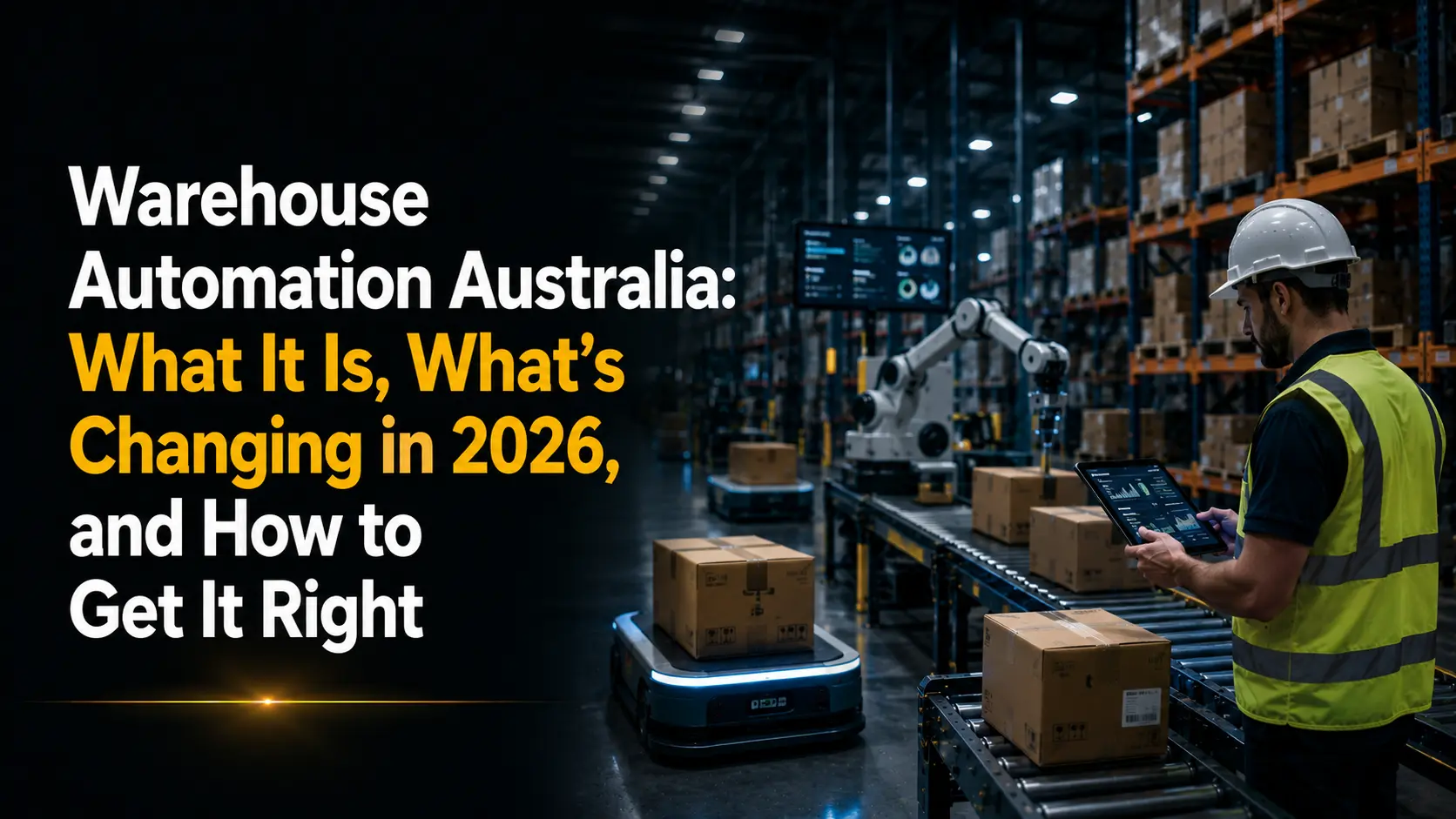
Warehouse automation is rapidly expanding in Australia.
Autonomous robots and automated sortation systems were investments large distribution centres made a few years ago. Not medium-size importers or expansion e-commerce ventures.
That’s changed. Warehouse automation and last-mile delivery innovations are now being scaled up across Australia’s transportation and logistics networks, advancing speed and flexibility for businesses of all sizes, FedEx’s 2026 Australia Logistics Trends Report says.
Those that grasp the potential of warehouse automation, and are already putting it in place are creating a real competitive edge. Those who wait, fall further behind, each quarter.
In this guide, you will learn the true meaning of warehouse automation, the warehouse automation technologies being used in Australia today, when to invest in warehouse automation, and how to do it without spending money on the wrong solution.
What Is Warehouse Automation?
Warehouse Automation is the application of technology (robots, software, sensors, automated systems) to warehouse operations that are currently carried out manually, such as receiving, putaway, picking, packing, sorting and despatch.
It’s not one technology. It’s a spectrum. Simple automation such as barcode scanning and conveyor belts at one end. At the other extreme are completely automated distribution centres where robots perform every aspect of the fulfilment process with very little interaction from humans.
The majority of Australian businesses that are considering warehouse automation in 2026 are in the middle. Automation of certain high volume tasks (such as picking/sorting/packing) with continued people involvement in more judgmental or flexible tasks.
Also, Warehouse Automation Australia is not simply an effort of replacing manpower. It’s simply a matter of utilizing the resources more efficiently. Improving accuracy. Reducing error rates. Speeding up throughput. And creating an operation that scales, but not the same amount that you scale the head count.
Why Warehouse Automation Matters for Australian Businesses Right Now
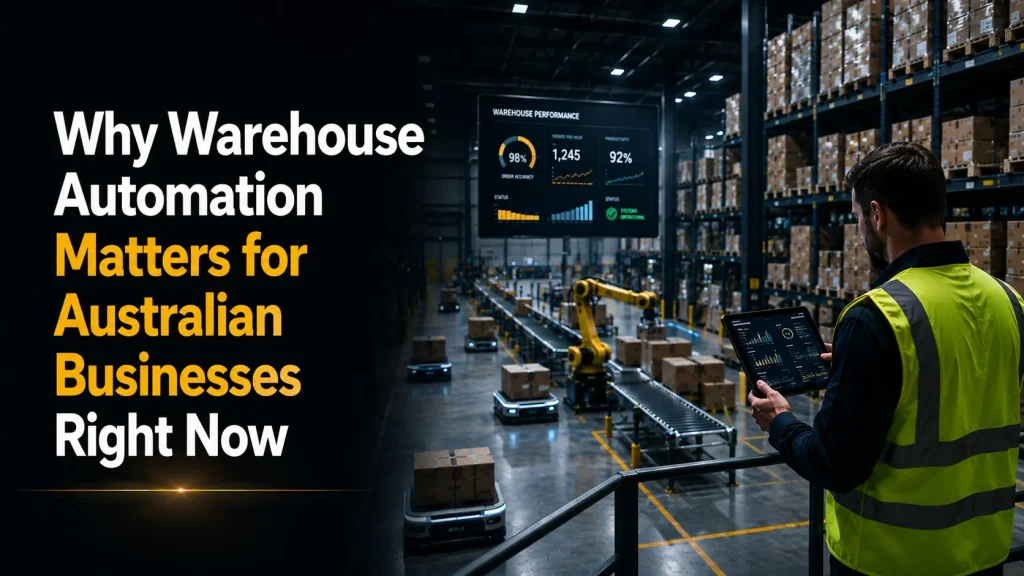
Australian businesses in 2026 will benefit from warehouse automation due to the labour shortages, wage inflation, growth of e-commerce and the demand for more rapid and accurate fulfilment from customers.
There are multiple drivers that are creating an environment where automation is becoming more than just desirable, it’s essential for many operations.
Labour Shortages and Rising Wages
There is a shortage of skills in the warehousing sector in Australia. Staffing is a big problem, and it’s not just the warehouse picking, packing and sortation jobs. The recruitment of quality, skilled warehouse personnel continues to be a challenge and is becoming more costlier.
This has been further exacerbated by minimum wage hikes in the past year. The labour-intensive method of order fulfillment is becoming increasingly expensive. Automation does not mean the end of the warehouse employee it’s just that the same team can process considerably more orders in the same amount of time.
E-commerce Growth and Volume Spikes
Australian ecommerce trends will keep going on and as always, it’s essential to know the newest trends in logistics and supply chain management to remain competitive. This expansion directly feeds into increased volumes in warehouses, quicker fulfillment expectations and more complex orders.
Peak season volume surges are getting bigger Black Friday, Click Frenzy, Christmas. If the warehouse works well when the volumes are average and fails to work when they are high then it’s a business problem. Elastic capacity is provided by automation. Robots don’t get sick during the Christmas rush.
Customer Expectations
The new expectation of same day and next day delivery changes the criteria of what the warehouse needs to provide. Morning orders are midday orders. This is something that must be done quickly and accurately, something that manual operations are hard pressed to maintain on a consistent basis.
In addition, there has been an increase in expectations for accurate orders. When customers get the wrong item, they do not just return it, but also write negative reviews and never return. The accuracy of automated picking systems is consistently 99.9% or more. Typically picking is done by hand at 97% – 99% while this sounds good, it means thousands of errors a year at scale.
Types of Warehouse Automation Being Used in Australia
Unmanned mobile robots, automated sortation systems, goods-to-person systems, automated storage and retrieval systems (ASRS) and AI-powered warehouse management systems are being introduced to Australian warehouses as part of the push to deploy them in these spaces.
Here are the things these really do.
Autonomous Mobile Robots (AMRs)
AMRs are robots that move around on the warehouse floor without relying on permanent infrastructure, such as conveyors, tracks, or making changes to the room itself. They are able to navigate around people and obstacles dynamically using cameras, sensors, and AI.
AMRs are designed for picking by moving the shelving unit to the picking person, instead of the picking person walking to the shelving unit. This “goods-to-person” approach can significantly cut down travel time per pick. Research has continually found that picking travel time makes up between 50% and 70% of overall picking time. Most of that travel can be eliminated, doubling or tripling effective pick rates.
AMRs are now commercially feasible for medium-sized Australian business operations. For instance, Locus Robotics, 6 River Systems and Geek+ offer systems that can be installed in current warehouses, meaning there is less risk and cost involved in implementing the system.
Automated Sortation Systems
Items are automatically sorted into the appropriate despatch lane by the sortation system according to carrier, postcode or order profile. They are most likely to be found in high-volume fulfilment processes, such as large retailers, third-party logistics providers and parcel couriers.
The manual sortation process (people reading labels and putting items into the right chutes) is slow and prone to error. Automated sortation systems can sort thousands of items per hour, to near perfection.
Automated sortation is one of the most return-on-investment automation solutions available to Australian businesses that send large numbers of parcels.
Goods-to-Person Systems
Goods to person systems move the product to a stationary picker workstation, as opposed to sending pickers to the product. This can be done by using AMRs, vertical lift modules or carousel systems.
This means there is a considerable decrease in pick time and walking distance. Well-designed goods-to-person stations enable pickers to receive two-to-three times more orders per hour than pickers in a traditional shelving aisle.
Automated Storage and Retrieval Systems (ASRS)
Automated cranes and shuttles are used for inventory storage and retrieval in ASRS systems, which are high-density racking systems. They provide more storage in a smaller footprint – higher cubic metres of inventory per square metre than traditional shelving.
ASRS is an ideal solution for Australian businesses looking to lower warehouse space needs to store a specific product volume in Sydney, Melbourne and Brisbane when warehouses are expensive. This is especially useful because industrial property prices have increased considerably in the last few years in the metropolitan areas of Australia.
AI-Powered Warehouse Management Systems (WMS)
The modern WMS is the backbone of the warehouse operation. It controls receiving, putaway, picking, packing and despatch. It maximises pick paths. It automatically fine-tunes slotting according to product velocity. Forecasts and alerts to stock-outs. It also integrates with e-commerce and ERP and carrier systems to ensure data continues to flow through the supply chain.
AI-powered WMS platforms do more than that; with machine learning, they continually optimize based on real-world performance. They identify inefficiencies that human managers don’t have the bandwidth to spot. They forecast demand and stock up inventory accordingly.
Also, a proper WMS becomes the basis for other investments in automation to function correctly. Robots that are not well programmed simply do not perform. The value of the software investment is usually similar to the value of the hardware.
When Does Warehouse Automation Make Sense?
The economic viability of warehouse automation depends on the number of orders being placed: for a few hundred orders per day and any technology, automation costs less than the cost of labour, errors and missed orders.
Not all warehouses need to be automated. Not yet. There is, however, a clear indication that there is a return on investment for automation.
Order volume is growing consistently. The up-front cost of automating is the investment in robots, systems and software. When more orders are made, there is a larger denominator, making the fixed cost economics look better. A business that processes 500 transactions a day returns higher ROI on the investment in automation than a business with 100.
Labour is a consistent bottleneck. If the issue of throughput is the availability of warehouse work staff and not equipment or space, automation solves the problem first.
Error rates are too high. Manual picking errors lead to returns, complaints and re-work. Errors that exceed 1% to 2% at scale may well be worth an investment in automation.
Peak season is consistently overwhelming. Then, if volume increases during Black Friday or Christmas (and you don’t have the manpower to manage it) despatches are delayed, service levels are compromised or you need to take on temporary workers, which costs a fortune – then automation with elastic capacity can solve the problem structurally.
Warehouse space is expensive. When warehouse rents are a major expense (as they are in Sydney, Melbourne and Brisbane) automation that boosts throughput per square metre or cuts down on the amount of space needed for the same throughput can be beneficial in terms of rent savings as well as labour savings.
How to Approach Warehouse Automation in Australia
The path towards successful warehouse automation begins with a thorough operational audit, pinpoints the highest value automation opportunities, systematically analyzes technology options and takes a staged approach to implementation to minimize risk.
Many Australian businesses end up going to a demonstration of the technology, are impressed and then trying to translate that back into a business case. This way, you always end up with substandard implementations.
The right first step is the operational problem. What is the rate limiting factor? What is going wrong? How much does it cost per order today and what would it have to cost to be competitive? The solutions for these questions determine what sort of automation is going to be useful and how much.
Start With a Warehouse Audit
A structured warehouse audit records the current performance (pick-rates, error rates, travel distances, labour cost per order and space utilisation) and compares it to what is possible. It brings to the surface the bottlenecks. It prioritises the opportunities. And it offers the information to create a strong and valid business justification for investing in automation.
If they don’t audit, companies frequently purchase automation tools that tackle a visible symptom instead of the root of the problem. If the business does not optimize their slotting and WMS before implementing AMR, the performance of the robots will not meet expectations, since they will be relying on bad data.
Evaluate Technology Options Systematically
The warehouse automation technology market is competitive. More than 30 AMR providers. Multiple WMS vendors. Various ASRS configurations. The only way to make a good choice is to have a structured evaluation process, establishing requirements clearly, scoring the options against the requirements, then testing the short-listed solutions in a proof of concept before committing to one.
Moreover, its integration is very significant. If automation technology is isolated from the current WMS, ERP or ecommerce system, it will cause more issues than solutions. Integration should be tested not just promised before a purchase decision is made.
Implement in Phases
A one-step automation of a warehouse operation is a high-risk solution and is usually not a requirement. The implementation is gradual and starts with the highest value and lowest risk automation, and gradually introduces more and more capabilities, thus minimizing risks, giving the team time to adjust, and providing value before they move on to the next phase.
For the better part of Australian businesses, the first step is to embrace a modern WMS that integrates AI optimization features. This provides instant–time–of–day enhancement in pick accuracy, slotting productivity and labour productivity without the capital investment of robotics. If the WMS has been embedded and has been successful in providing the data, then the business case for continuing with further investment in automation becomes that much stronger.
Warehouse Automation and Supply Chain Consulting
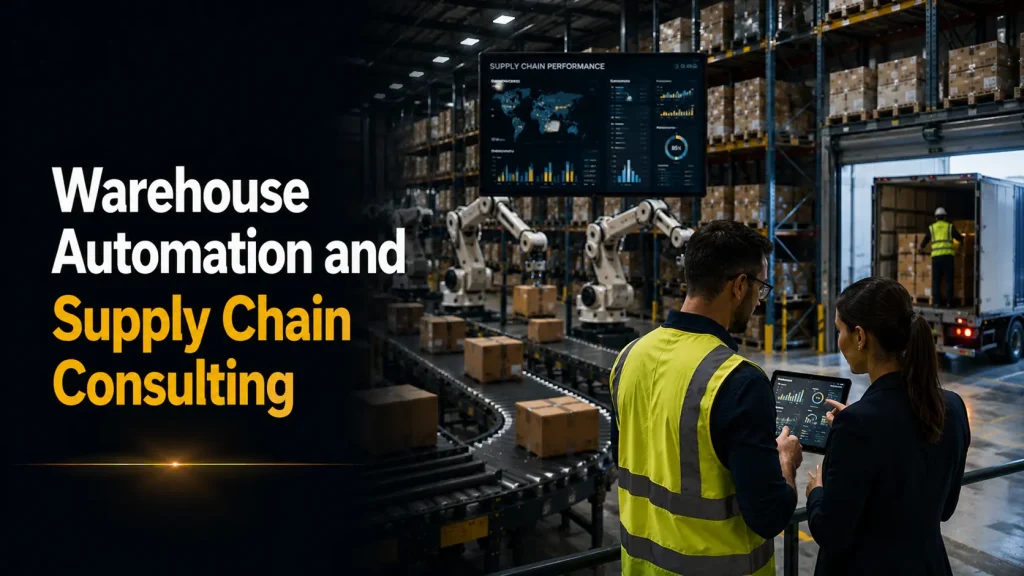
Warehouse automation isn’t an independent affair. It is linked to all other areas of the supply chain.
Automating a warehouse is also a choice regarding stock management, order entry from sales channels to warehouse, freight dispatch and warehouse stock return. As critical as the warehouse technology is the ability to get these upstream and downstream connections right.
This is where supply chain consulting comes in handy in warehouse automation projects. A consultant who knows warehouse operations and technology and who also knows about inventory management, freight, customs and demand planning can assist businesses in making decisions about warehouse automation that make sense for the entire supply chain, not just the four walls of the warehouse.
This all-in-one approach is what FR8WISE offers in warehouse automation consulting. We’ve assisted Australian businesses to undertake warehouse audits that revealed automation opportunities that they had not realised. We’ve helped to conduct technology evaluations that achieved better outcomes than businesses could have achieved if they had chosen technology themselves. And we have been successful in getting automation projects up and running that have met expectations, not just close to them.
Think Global Logistics (TGL) provides specialist consultancy for all aspects of supply chain beyond warehouse automation, such as demand planning, freight optimisation and customs compliance.
How FR8WISE Supports Warehouse Automation in Australia
The supply chain team at FR8WISE collaborates with Australian companies to design, analyse and deploy warehouse automation solutions that deliver tangible benefits in the way that the company operates.
The warehouse automation consulting services we provide include:
Warehouse audit and baseline assessment. A detailed assessment of existing warehouse processes, including pick accuracy, error rates, labour cost per pick, warehouse space utilisation and more, to determine where automation could have the biggest impact.
Technology evaluation support. Assisting businesses to systematically understand their requirements, assess AMR, WMS, ASRS and sortation solutions and narrow down the solution to suit their specific business operations.
Business case development.Developing convincing business cases for warehouse automation investment such as ROI analysis, payback period calculation and sensitivity analysis.
Implementation management. Successful warehouse automation project management: integration testing, training staff, and measuring automation.
WMS selection and optimisation. Assisting businesses in identifying and utilizing the right warehouse management systems that give them the information and guidance they require to optimize both human and automated operations.
If you’re thinking about first warehouse automation investment, assessing warehouse automation for a particular operation, or just want to know why an automated installation isn’t achieving the expected results, FR8WISE has the expertise to help.
Frequently Asked Questions: Warehouse Automation Australia
What is warehouse automation?
Warehouse automation refers to the implementation of technology, such as robots, software, automated systems and sensors, to automate tasks in the warehouse that were previously carried out manually, such as picking, packing, sorting, receiving and despatch.
What types of warehouse automation are being used in Australia?
In the warehouses of Australia, these types of autonomous mobile robots (AMRs), automated sortation systems, goods-to-person systems, automated storage and retrieval systems (ASRS), and AI-powered warehouse management systems are being used. The proper technology is dependent on both product type and order volume as well as operational needs.
How much does warehouse automation cost in Australia?
These costs are very technology and scale dependent. An AMR system for a mid-sized operation might cost $200,000 to $500,000. The cost of a full implementation of a WMS varies depending on complexity from $50,000 to several hundred thousand dollars. The process of installing an ASRS system is usually a multi-million dollar process. Most implementations show savings in labour costs and efficiency within two to four years.
When does warehouse automation make sense?
In general, above 200 to 500 orders per day (OPAD) (depending on the technology). Common indicators are persistent labour shortages, increased error rates, capacity issues during peak seasons and increased order cost per item. A warehouse audit can be used to see if the benefits of automating a given operation make economic sense.
Does warehouse automation replace human workers?
Not usually in full bloom. Automation does not replace jobs, it replaces the tasks people do. Pickers are not walking the warehouse on their own but are working together with robots. There are still areas, such as quality control, exception handling, inbound receiving, and system management, that require human judgment. Businesses discover that they can manage considerably more transactions with the exact same number of staff members after they automate versus cutting back staff members.
How long does it take to implement warehouse automation?
It requires 2-6 months to implement WMS. AMR deployments can be live within 4 to 12 weeks after they’ve been decided. Installation of more complex ASRS can take anywhere from twelve to twenty four months from decision to operation. The phased implementation process (highest value first) cuts down time to first return.
How does warehouse automation connect to the rest of the supply chain?
These are the impacts of warehouse automation on inventory management, order flow from sales channels, freight despatch and returns flow. These upstream and downstream linkages need to be factored into the decisions made during the design of a warehouse automation workstation, which is why integrated supply chain expertise is important in automation projects.