


Written by the FR8WISE Supply Chain Team | FR8WISE is a Sydney-based supply chain consulting firm working with Australian businesses across 14 industries to improve procurement, logistics, freight operations, and end-to-end supply chain performance.
Few supply chain issues make themselves known.
They build quietly. Rising freight costs. Failing to have food when they need it most. Successful warehouse operations that were successful at half the volume. No formal relationship with suppliers. The problem appears on the screen only when it is visible enough to take action on and has been costing money for months already.
That’s where supply chain consulting Australia comes in. Those early hiring specialists do better. They proactively overcome problems rather than crises. The people who wait until they feel the pain only spend more money and end up doing less.
This blog gives you an overview of what supply chain consulting is really about. Where applicable. Key attributes of a consulting partner. And how Aussie businesses are putting it to work to create effective supply chains.
What Is Supply Chain Consulting?
Supply chain consulting involves offering specialized knowledge and skills to assist companies in designing, optimizing, and running their supply chains, from procurement to logistics, warehousing, freight, customs compliance, and overall supply chain strategy.
It’s not the same as logistics outsourcing. A supply chain consultant analyses what’s happening in your business. They pinpoint areas of lost value. Afterwards they assist you with creating a better system. This could require re-negotiating carrier contracts. Redesigning warehouse layouts. Having multiple suppliers. Or developing a working demand planning capability.
Consulting in Australia comes in a myriad of forms under the title of supply chain consulting. Some consultants focus on a particular niche such as warehouse design, transport procurement or customs compliance. Others have a different perspective. They operate throughout the supply chain looking for the highest opportunities and develop an improvement roadmap to solve them.
The broader perspective is held by FR8WISE. There is no single issue when it comes to supply chain issues. A solution that has no relationship to the other pieces tends to fizzle out when it comes to solving one piece.
Why Australian Businesses Need Supply Chain Consulting
Supply chain consulting in Australia can answer questions that are unique to the Australian market, such as:
Australian supply chains are subject to a set of pressures not found in any other combination. The first step towards creating something that actually functions here is to understand them.
The Distance Challenge
Australia is a large area with a small population concentrated in a small land mass. The distances between Sydney, Melbourne, Brisbane, Perth and Adelaide are distances most developed markets never have to face when moving goods between these cities. Sydney to Perth is approximately 4,000 kilometres, or 6 times the distance from London to Moscow.
The distances for international trade are even greater. Weighing in as major trading partners, China, Japan, the US, South Korea, and ASEAN are just a few weeks away by sea. Those travel times can make inventory planning a real challenge. They don’t exist in the same way in Europe or North America.
The Cost Challenge
Australia’s logistics costs are also high. The cost of fuel, shipping charges, port dues, charges in the warehouse are all higher here than in most similar markets. Freight and logistics can account for 10-15% of the revenues for many businesses. In certain fields, it’s higher. This cost base must be managed in a more than a good intention way. It calls for systematic analysis, robust carrier relationships and purposeful choices over the structure of the supply chain.
The Compliance Challenge
When importing and exporting products into/from Australia, you need to deal with Australian Border Force regulations. Biosecurity legislation. Therapeutic goods: Regulations of TGA. Food safety standards. And a complicated matrix of free trade agreements which can substantially cut duty costs, provided they’re claimed properly. Compliance is costly. Accurate results depends on the expertise that most companies don’t have in-house.
The Growth Challenge
Numerous Australian companies develop supply chains, which are designed to a particular size. Otherwise, they do not come back to them when the company grows. A $10m revenue chain is easy to crash at $50m. The warehouse layout is not scalable. There isn’t a strong carrier relationship. Manual inventory management systems can’t keep up when volumes get larger. With a supply chain consulting solution, businesses can avoid getting caught up in these turnarounds instead of reacting to them.
What Does a Supply Chain Consultant Do?
A supply chain expert reviews your existing business, pinpoints areas of highest cost, risk and inefficiency and assists you to plan and design practical solutions for the supply chain from procurement, logistics, warehousing, freight and compliance.
The work is unique for the company and the challenge. Most supply chain consulting projects in Australia run along the same lines, however.
Supply Chain Audit and Diagnostic
Most consulting projects begin with a detailed analysis of the existing supply chain. This involves identifying the journey of goods from supplier to customer, measuring performance against benchmark, understanding the key cost drivers and identifying the gaps.
A good supply chain audit brings up items which are not readily apparent from within the business. One thing is likely to come as a surprise when you conduct a freight spend analysis. Various divisions are charging carriers different prices. Why? Since nobody ever rolled up the spend and negotiated on the total volume. In a warehouse audit, it is often discovered that fast-moving products end up in the wrong location, for example. This is an unnecessary time-waster for each and every pick.
Procurement and Supplier Strategy
Supplier selection, contract negotiation, performance management and risk diversification. Supplier relationships existed in many Australian businesses before the current business climate. These are not official reviews. As a result, they’re paying above-market prices. They’re taking service at under-market rates. Or they possess an unneeded concentration risk due to single sourcing.
A supply chain consultant can assist companies to gain an understanding of good supplier arrangements. They compare existing contracts to the market. They establish procurement processes that consistently achieve better results – not only if someone can be bothered to renegotiate
Freight and Logistics Optimisation
Carrier selection, rate negotiation, mode optimisation and network design. Freight is often the biggest controllable in the supply chain for many Australian businesses. It’s also that one that receives the least systematic attention.
When performing a freight spend analysis, there are several opportunities to drive down costs without compromising the level of service. Uniting multiple volumes on a single carrier. Reducing LCL freight through size optimization. Transiting from air to sea for non-time sensitive items. Re-negotiating deals that haven’t been addressed for years at a time. All these typically provide a 10%-20% or more cut in total freight spend.
Warehouse and Inventory Optimisation
Warehouse design, slotting, order picking, inventory control and optimisation. A warehouse expert consultant can inspect a facility and offer practical advancements. They save on labour expenses per order. They improve accuracy. They increase throughput. Without the need to add extra space or technology.
Many businesses have more inventory than they require. Why? So, they don’t trust their demand forecasting, and therefore they have buffer stock everywhere, as a safety factor. A better forecast and development of a systematic safety stock approach can help decrease investment in inventory. Meanwhile, there are also fewer incidences of stockouts.
Customs and Trade Compliance
Tariff classification review, identification of FTA concessions, biosecurity compliance and customs process improvement. A duty saving audit of a business’s customs compliance is often an FTA compliance review and tariff classification optimization project for businesses regularly importing.
This is one of the highest pay-off portions of the supply chain consulting (SCCP) area of the business for Australian importers. The benefits of a proper FTA claim for concessions could be significant. Duty savings run through instantly unlike process improvements, which normally take some time to implement. Classification and origin documentation is all that is required.
Technology Assessment and Implementation
Choosing and deploying the appropriate supply chain technology is a complicated process. There is high competition in the market. It can be hard to assess the claims made on a marketing website without special knowledge. Such as demand planning software, warehouse management systems (WMS), transport management systems (TMS), and visibility platforms.
A supply chain consultant enables businesses to grasp the technology they really require. What the business needs, not what vendors are offering. They consider alternatives according to criteria. They do not just go live and hope for the best when it comes to implementation, but rather do it to obtain the anticipated benefits.
When Should a Business Engage a Supply Chain Consultant?
The best time to hire supply chain consultants in Australia is when a business is scaling fast, if it has regular issues with its supply chain, if it is entering new markets, when it is under major cost pressures, or making a major operational change.
There is no one right or wrong trigger for consulting engagement. In some cases, however, outside consultants would be of value.
Rapid growth. Businesses that expand faster than their supply chain can keep up with will experience issues that escalate rapidly. The infrastructure, too, should be in place before the growth curve, at least in part, with the help of a supply chain consultant. This way, the business doesn’t have to be constantly responding to bottlenecks.
Recurring problems. When these problems continue to happen you’re out of stock during busy seasons, your carriers are late, your inventory isn’t on track, something is deeper. Root cause has not been well understood and solved. Therefore with external expertise the cycle is broken.
Major operational change. They all add to supply chain complexity when they are involved in a new market entry, launching into a new product category or when they transition from in house fulfillment to a 3PL, or when a large-scale acquisition takes place. Favored input helps you conquer it without expensive blunders.
Cost pressure. A systematic review of the supply chain often reveals savings when margins are being squeezed, freight costs or logistics costs are significant, or they are part of the business. Insiders are too close to the action. They miss things that they would not miss if they were outside.
Post-disruption recovery. Major supply chain disruptions, such as supplier failure or a port closure or product recall will require a structured rebuild of the supply chain. Not a patch-up. In addition, with consulting support, the rebuild can create a system that is more resilient than what existed before the disruption.
What to Look for in a Supply Chain Consulting Partner in Australia
The key to selecting the right supply chain consulting partner is the one that has relevant industry experience, a proven ability to operate with you, transparency in approach and pricing, as well as a proven track record of delivering measurable results.
Not every consultant is a “consultant.Not every consultant is a “consultant”. These are the things that make them good.
Operational Experience, Not Just Frameworks
The top supply chain consultants have been on the job, working in supply chain operations — not just studying them from the outside. They’ve managed warehouses. Negotiated freight contracts. Addressed biosecurity “holds”. Managed day to day fact of moving goods across Australian customs. Therefore, their recommendations are based on not only looking good in a presentation, but actually working in practice.
Industry Relevance
Food and agriculture versus pharmaceutical distribution or e-commerce retail versus mining.There are challenges in the food and agriculture value chain, which are different from those in the pharmaceutical value chain or retail e-commerce or the mining value chain. A specific industry expert consulting partner will have the industry understanding. They will be familiar with the career situation. They’ll be familiar with the requirements of your sector in terms of operating requirements.
Transparency
A successful consultancy partner is honest from the get-go. The work and activities of the engagement. The results you may expect. Duration of the activity. What it will cost. Broadly worded scope and engagements that are not clearly defined are a warning sign. Moreover, if a consultant tells you that everything is fine, then he is not adding value. You are paying for an honest assessment of the problem, even if it’s uncomfortable.
Implementation Capability
Analysis is nothing without implementation. The best supply chain consultants don’t only diagnose, they help you implement the changes, manage the transition and measure the results. Seek an ally who is willing to remain committed for implementation. Not one who walks away with a presentation and leaves us.
References
Request references from businesses like yours with a similar size, industry and trade profile. The best way to tell what you’ll receive is to have a history of success with businesses similar to yours.
The ROI of Supply Chain Consulting in Australia
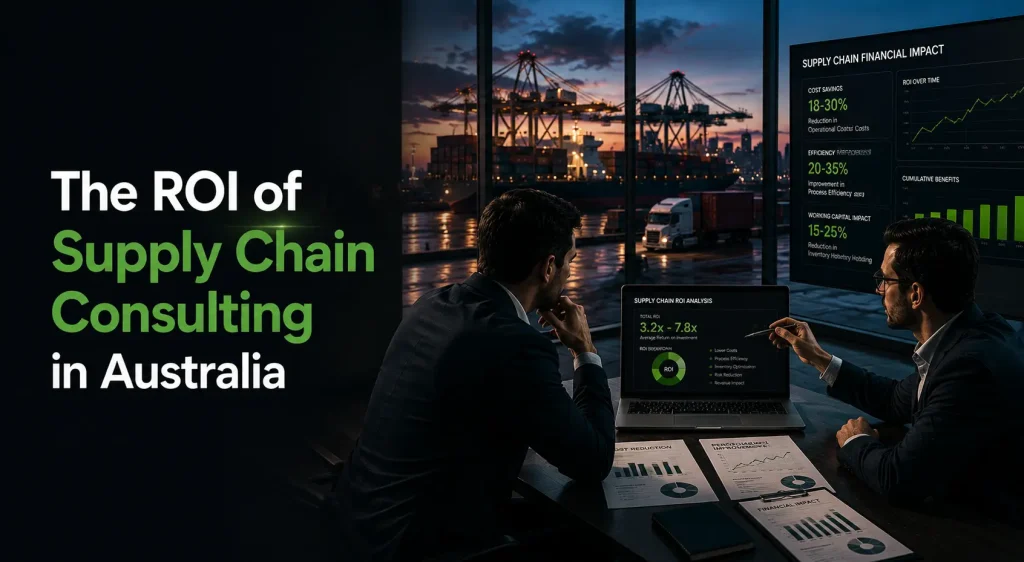
Duty saving, freight cost reduction, inventory optimisation and labour efficiency improvement are the key areas where ROI for consulting services in the supply chain sector is realised in Australia returns of 5-10 times the consulting fee are often realised within 12 months.
This is not an academic statement. It’s rooted in patterns that occur in every engagement in the supply chain consulting space.
Duty savings from FTA concession claims Often the first to be realised are the are. Imagine a company brings in $5 million worth of Chinese products. Previously paying 5% duty. Paying 0% under ChAFTA. This is a saving of $250,000 per year, from a compliance change, not an operational overhaul.
Freight cost reduction Carrier renegotiation and network optimisation often result in cost savings of 10% to 20% of overall freight costs. That translates to $200,000 to $400,000 in annual savings for the $2 million a year business that is spending on freight.
Inventory optimization Makes working capital available. If the business has $10 million worth of inventory and is able to decrease its average inventory by 15% by implementing effective demand planning, it will be able to release $1.5 million in cash. This is when service levels are also likely to increase.
Labour efficiency Better slotting, directed picking and process redesign in the warehouse will typically lower the labour cost per order by 15% to 25%.
These enhancements add up to a significant improvement. In addition, implementing supply chain improvements isn’t something that is executed once and never repeated, but rather builds upon itself over time. The benefits continue. As the company expands, they frequently start to grow.
Frequently Asked Questions:
What is supply chain consulting?
Consulting services in the field of supply chain management are the services that are provided to a business for the purpose of enhancing the latter’s supply chain. Includes procurement, logistics, warehousing, freight, customs compliance, and supply chain strategy. A consultant reviews the existing system, looks at the value stream, and designs and implements changes that will make a practical difference.
How much does supply chain consulting cost in Australia?
The rates for consulting services are determined based on size and duration. If you’re focusing on freight spend analysis, the cost could be a few thousand dollars. A comprehensive supply chain audit and improvement programme can cost $50,000 or more. The ROI generated from well-designed supply chain consulting, however, is oftentimes significantly higher than the consulting fees within 12 months.
How long does a supply chain consulting engagement take?
This is dependent upon the extent. It can take between 4 and 8 weeks for the focused freight procurement project. It could take 3-6 months for a full audit and improvement plan to be drawn up. Implementation of suggested changes will most often require 6-18 months depending on the complexity.
What industries benefit most from supply chain consulting in Australia?
Supply chain consulting can bring value to just about any industry that involves moving goods. It generally has the biggest impact in complex supply chains, high freight costs, high import/export volumes and compliance regulations (food and agriculture, retail and e-commerce, healthcare and pharmaceuticals, manufacturing, construction and resources).
What is the difference between supply chain consulting and logistics outsourcing?
Supply Chain Consulting is when an outside specialist comes in to assist in enhancing your Supply Chain but you maintain ownership and control of the entire process. Logistics outsourcing includes delegating the responsibility for managing a component of the supply chain to an external party (3PL). Both can add value. Often they go hand in hand: a supply chain consultant can guide you towards finding and managing the right 3PL.
How do I know if my business needs supply chain consulting?
Signals may be increasing freight costs, regular stock outs or overstocking, lagging delivery performance, rapid growth of the business that the supply chain cannot keep up with, a significant change in the way the business operates in the near future, or simply the feeling that the supply chain has not been systematically reviewed in many years. If these apply, a supply chain review probably will pay for itself.
Can supply chain consulting help reduce customs duty costs?
Yes. A customs compliance review typically reveals a lot of duty savings for businesses importing goods to Australia. By properly handling FTA claims. By the optimised tariff classification. Increased documentation of processes. The savings can be significant – especially in the case of importers coming from FTA partner countries like China, the US, Japan, South Korea and the ASEAN countries.
How FR8WISE Delivers Supply Chain Consulting in Australia
Sydney-based FR8WISE is a supply chain consulting business serving Australian businesses in 14 industries, including food and agriculture, retail, e-commerce, construction, health and medical care, pharmaceuticals, manufacturing, mining and more.
The unique strength of FR8WISE lies in its strategic consulting power along with its rich operational expertise. The team has been involved in the supply chain process and not merely in providing advice on it. Recommendations are based on those that are proven to be effective in the Australian market. Not designed from abroad to suit the local context and obstacles.
The first step in FR8WISE’s consulting model is to conduct a comprehensive diagnostic. Knowing the existing supply chain. Establishing improvement opportunities with the greatest value. Ranking them by impact and complexity of implementation. The team then collaborates with clients to make change, facilitate transition, and track outcomes.
Procurement and supplier strategy. FR8WISE provides businesses with a resource for reviewing and renegotiating suppliers’ contracts. They establish multi-sourcing strategies to minimise concentration risk. And they build procurement processes that consistently achieve improved results.
Freight forwarding and customs compliance. The team handles international freight and customs clearance along with an integrated service. Goods move efficiently. FTA Concess: Claimed properly. In advance biosecurity needs are identified and addressed.
Warehouse optimization. FR8WISE analyzes warehouse layouts, slotting and picking processes. The aim is to make improvements that will decrease the labour cost per order and increase the accuracy. Without the need for extensive capital investments.
Inventory management and demand planning. The team enables businesses to develop their own demand planning capabilities to minimize stock out and overstock situations, thereby freeing up working capital and providing better service.
Supply chain technology. By helping businesses assess and adopt the optimal supply chain technology demand planning software, warehouse management systems, transport management systems and visibility platforms according to their size and requirements, FR8WISE will assist them in making the right choice.
The FR8WISE Mastery in Supply Chain and Logistics programme also enhances the capacity of client organisations. Improvements get sustained. Over time, the business builds up its own expertise in the supply chain.
Think Global Logistics (TGL) provides specialist services for businesses looking at a wider international trade strategy as well as supply chain consultation services through the whole international trade chain picture, including global network design and optimisation of trade lanes.
Whether you are paying more than you need to, or your supply chain is less reliable than you would like, or simply you and your business haven’t thought about your supply chain in the context of your business’s future FR8WISE has the answer.
FR8WISE — Strategic Supply Chain & Logistics Solutions | Sydney, Australia