


Written by the FR8WISE Supply Chain Team | FR8WISE is a Sydney-based logistics and supply chain consultancy working with Australian businesses across 14 industries to improve freight forwarding, customs compliance, and international supply chain performance.
Speed costs money. However, the price of delay may be greater in some instances.
Production line with a shortage of components. The store’s window is open before the products are in. Any pharmaceutical shipment with an expiration date. In such cases, it is not a choice of luxury but a necessity: air freight.
But air freight Australia is also poorly understood. It is not always used proactively as a part of a business’s logistics strategy but as a reactive measure, when sea freight is not fast enough. Consequently, they tend to pay more than required, send the wrong goods by plane, and fail to take advantage of strategic use of air freight.
This guide explains everything about air freight in Australia from the basics up. What it is, how it works, and what it costs, when it’s useful, how to use it well, and what new or changed industry offers are available.
What Is Air Freight?
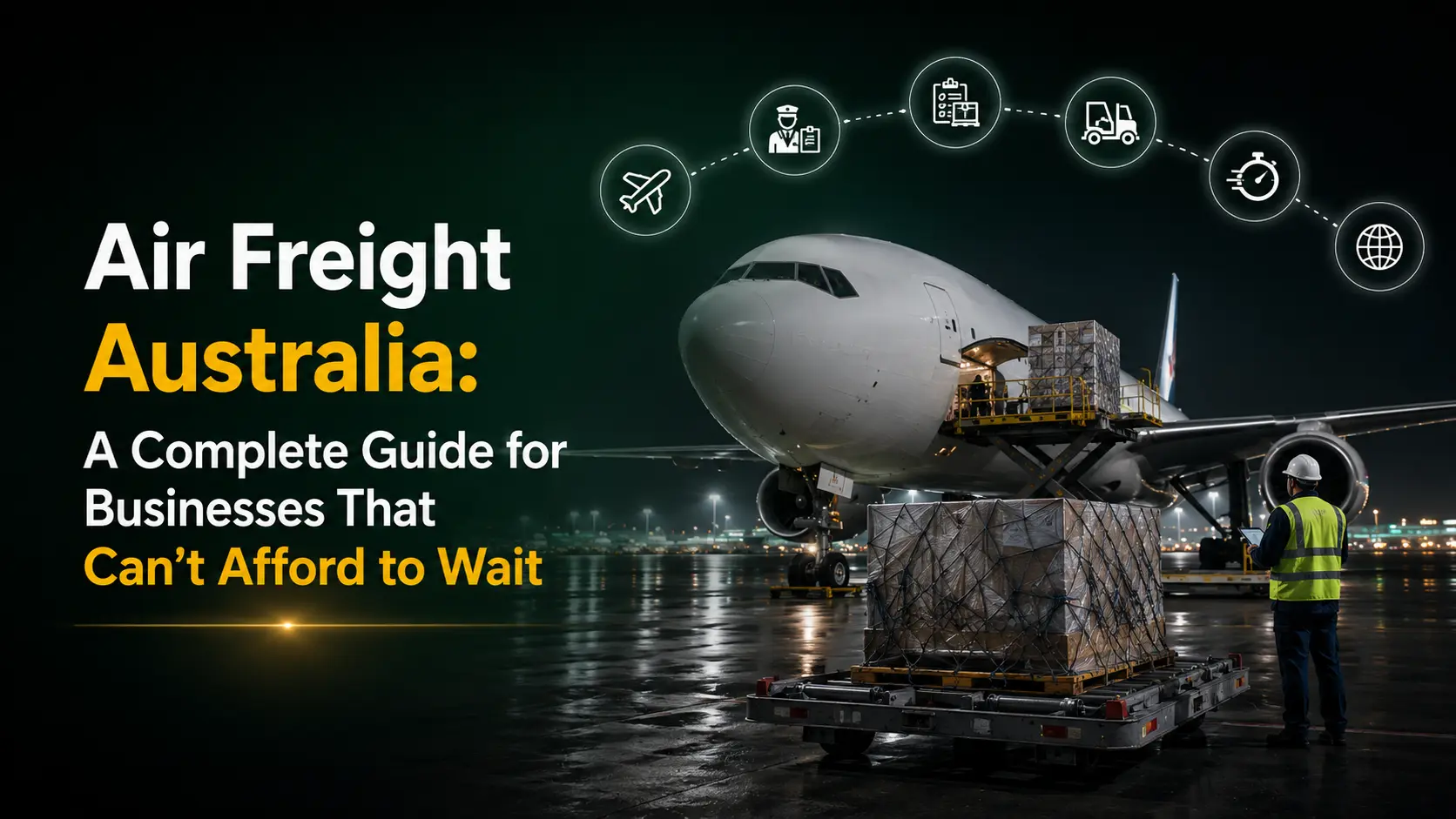
Air freight refers to the movement of commercial goods transported by aircraft, usually by dedicated cargo aircraft or by the belly hold of passenger aircraft, which are typically employed for goods that need to be transported quickly, safely and with care.
It’s the fastest mode of international freight available. It’s possible for shipments to arrive in 3 to 5 days from Shanghai to Sydney via air, compared to the 12 to 22 days it normally takes to make the trip by sea. The contrast is even greater if the comparison is made with Europe or North America.
But there’s a price to speed. Five to ten times the sea freight rates for the same weight is the normal figure for air freight. Therefore, not every shipment will be suitable for air freight. The question of air/sea mode is dependent upon a clear understanding of the cost difference, value of goods and the cost of delay.
How Air Freight Works in Australia
Air freight is the process of consolidating cargo at the origin airport, loading it in a cargo or passenger aircraft, flying it to the destination airport, clearing customs and finally delivering it to the final destination.
There are a number of steps involved in the process. Each one is important for businesses to comprehend to better manage their air freight shipments.
Booking and Collection
Air freight starts with a booking, which can be done either directly with the airline or via a freight forwarder. The freight forwarder organizes the pickup from the supplier’s place of business and delivery to the origin airport. Importantly, the booking must be done beforehand, because there is a limit on the number of loads that can be carried on certain flights and during certain periods.
Export Customs Clearance
Cargo needs to be cleared for export by the customs authority in the country from which it is being exported before it can be loaded onto an aircraft. In most cases the freight forwarder will do this as part of their service. In addition, all cargo is screened before acceptance onto the aircraft – an increase since the 2010 air cargo security incidents.
Consolidation and Loading
The freight forwarder brings together each shipment at the origin airport into a Unit Load Device (ULD) which are standardized containers and pallets used on cargo and passenger aircraft. In cases of smaller loads, the freight forwarder can combine several customers’ loads into one ULD and, thereby, secure better freight rates. Sea freight refers to this as LCL (Less than Container Load) and in air freight it is called groupage.
Transit
The cargo is transported to the destination airport, either directly or via a hub airport. Singapore, Hong Kong or Dubai is a hub for many of the flights going to Australia from Asia. Hence, transit time will not only vary based on the direct flight schedule but also on connection times and availability of onward capacity.
Import Customs Clearance
Air freight will be cleared in Australia, as sea freight is done. Importer or their customs broker files an import declaration, pays import fees and taxes, and meets any biosecurity requirements. The time frame is shorter, however, for air freight as clearance must occur fast and without storage fees at the airport.
Delivery
After clearance, the freight will be delivered by the freight forwarder or by a carrier arranged by the freight forwarder. Sydney, Melbourne, Brisbane and Perth are the primary international air cargo centres of Australia and deliveries are usually made the same day as clearance is completed.
Types of Air Freight Services in Australia
There are several different types of air freight shipping in Australia available, each appropriate for particular shipping profiles, urgency, and price ranges.Air freight shipping is available in Australia in a number of forms, each suited to various freight profiles, urgency and price ranges.
Express Air Freight
The fastest option. Express services, such as FedEx, DHL and UPS, provide door-to-door shipping with guaranteed transit times, which are generally between one to three business days from various Asian cities to the Australian capitals. Services are packaged including full track and trace, customs clearance and delivery.
Express services are best for small, valuable parcels – spare parts, samples, documents, urgent pharmaceuticals. They are, however, most expensive per kg and not viable for large quantities
Standard Air Freight
Goods shipped via a freight forwarder on commercial air. More cost-effective than express services, particularly for larger shipments. Usually takes 3-5 days from Asia and 5-7 days from Europe and North America.
Normally, air freight will need to be arranged for customs clearance by the importer, either directly with their freight forwarder or customs broker. The overall time period is therefore longer than just the flight time, usually requiring an additional day or two for clearance and delivery.
Charter Air Freight
If the shipment is especially large or especially urgent, it may be necessary to hire a private plane. Charter air freight gives the shipper the freedom to route, schedule and handle the freight, but at a substantial price.
Charter services are used when commercial capacity is not available, when the shipping is too large, too sensitive to commercial handling or when speed is really a critical factor. Typical examples include humanitarian cargo, large industrial parts and time-critical automotive parts.
Hand-Carry and Courier Services
Hand-carry services are for very small packages that are very urgent, such as a critical spare part, a sample for a trade show, a signed contract in short, it is something that can be carried by hand on a commercial flight as personal luggage. It offers the shortest door to door journey for small items and is very expensive per kg.
 Air Freight Rates: What You Pay and Why
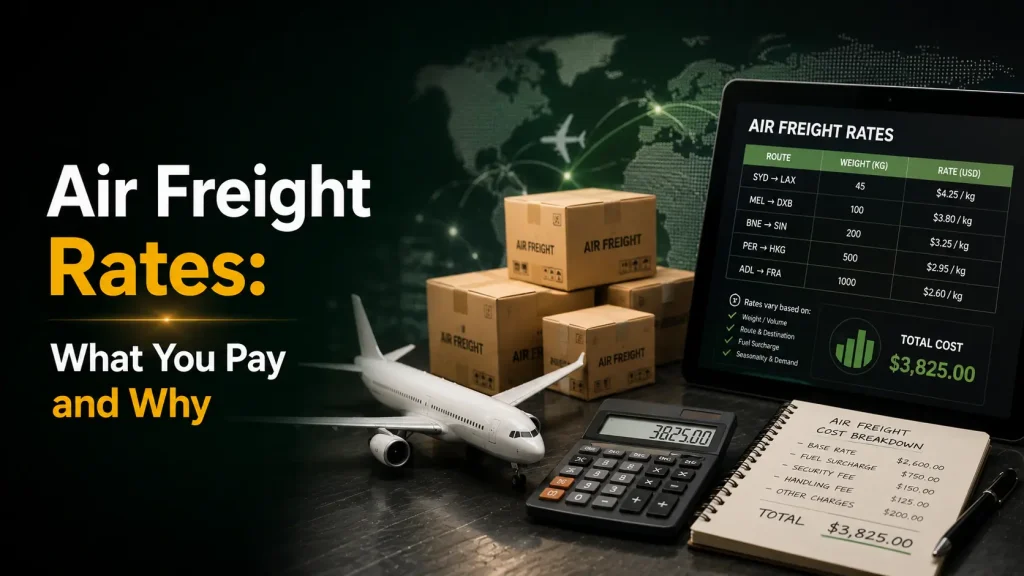
The charges made for air freight in Australia are determined by the chargeable weight (actual gross weight or volumetric weight, whichever is greater) plus fuel surcharges, security levies and destination charges.
Knowing the rate calculation helps the business to make informed decisions regarding mode selection, shipment consolidation, and packaging.
Chargeable Weight
The chargeable weight is the higher of:
- Gross weight: the actual weight of the shipment in kilograms
- Volumetric weight: calculated by dividing the volume in cubic centimetres by a factor of 6,000 (for most airlines)
In such a case, if you’re importing a shipment of lightweight packing foam that weighs 50kg on the scales, but occupies 1,000 litres, that’s a volumetric weight on the scales of 167 kg. In this instance, the freight rate will be charged for 167 kg, not 50kg. That means that the cost of sending a dense, heavy item by air will be cheaper than sending a light, bulky one.
Rate Components
Air freight rates typically include several components:
- Base rate: the core freight charge per kilogram, varying by route and market conditions
- Fuel surcharge (FSC): adjusts with fuel prices; can add significantly to the base rate
- Security surcharge: a flat or per-kilogram levy covering security screening costs
- Destination charges: handling fees at the destination airport, charged by the airline or ground handling agent
- Customs clearance fees: charged separately by the customs broker
- Delivery charges: for transport from the airport to the final destination
Moreover, high-demand premiums are imposed during peak seasons, the pre-Christmas season, Chinese New Year’s season and other peak demand seasons. Rates may rise 20% to 50% or more during these times and capacity may be very tight.
Indicative Rate Benchmarks
| Route | Indicative Rate Range (AUD/kg) |
| China to Australia (general cargo) | $4 — $8 |
| Southeast Asia to Australia | $4 — $7 |
| Europe to Australia | $6 — $12 |
| USA to Australia | $7 — $14 |
| Express courier (any origin) | $15 — $40+ |
The above are indicative only. Actual rates are subject to the various airlines, routes, weights, commodities and market conditions on booking.
When Does Air Freight Make Sense?
Air freight in Australia is an appropriate transportation method for goods that are time-sensitive, high value, perishables, urgent spare parts or trade show samples, where the cost of delay is greater than the cost premium compared to sea freight.
Not all shipments are suitable for air transport. There are definite instances, however, where air freight is the proper mode of transportation.
Time-Critical Inventory
The premium on air freight is often times less than the cost of the delay that would otherwise occur if there was a stockout that would halt production or production would lose sales. For instance, if a retailer is out of a popular item at the height of the season when people are most eager to purchase it, he or she loses the opportunity to sell right when it is most needed. So the air freight option to restock rapidly often makes sense when you consider the revenue generated.
High-Value Goods
When shipping high value merchandise – luxury goods, electronics, precision instruments, drugs, etc. – air freight costs are a fraction of the merchandise value. Additionally, air freight tends to be more secure than sea freight. Goods are handled at a lesser number of points, have a shorter journey and are subject to a greater level of security checks. This means that cargo loss/damage is usually lower for air freight than sea freight.
Perishable Goods
The foods that require shorter storage times, such as fresh produce, cut flowers, live seafood and chilled meat must get to their destinations quickly. For many fresh products, there is really only one international freight mode that’s viable: air. The import of Tasmanian lobster to Japan or fresh flowers from Melbourne to Singapore, for instance, rely totally on air freight to preserve product quality.
Urgent Spare Parts and Components
It is costly to have production downtime. The premium, in this instance, is usually a week or two of downtime, which is usually a lot more expensive than the cost of the air freight. Consequently, it is common in many manufacturing and resources companies to keep an air freight agreement to get their spare parts as quickly as possible.
Trade Show Samples
Samples, prototypes and show pieces for international trade shows must be delivered on time, and on a definite date. If you miss the trade show window, then all your marketing dollars are lost. Thus, for trade show shipments, air freight (with its specific transit times) is nearly always the answer.
New Product Launches
air freight will give the certainty that sea freight cannot, for a new product launch where the first shipment must arrive by a certain date. The additional expense is frequently outweighed by the need to launch on time for commercial purposes.
Air Freight vs Sea Freight: Choosing the Right Mode
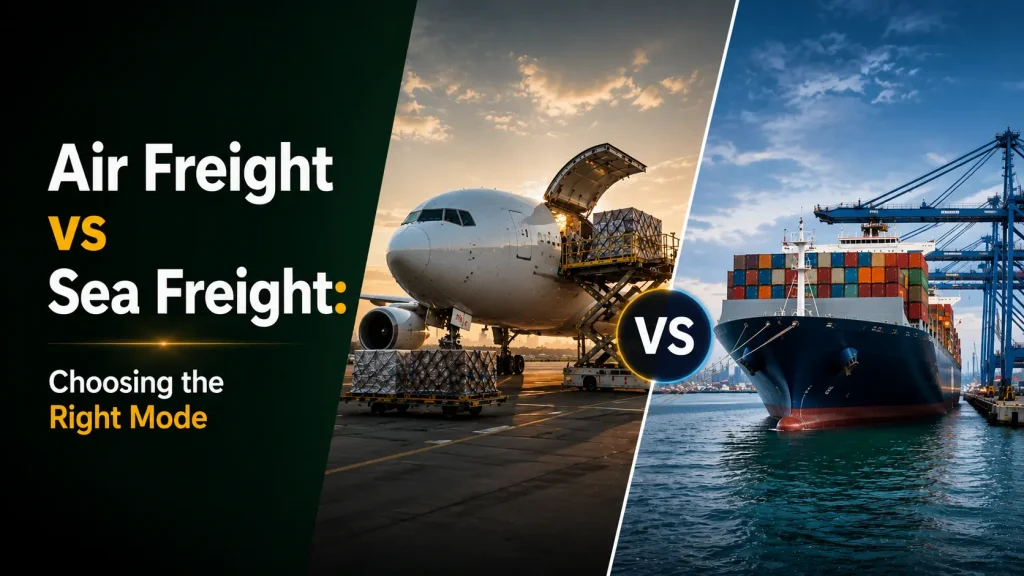
The choice between air freight and sea freight in Australia depends on the urgency, value, quantity of goods being sent, and the cost of speed versus wait.
Both modes have their advantages and disadvantages and are not always best. But it is important for businesses to be aware of the pros and cons of the two clearly before making a choice on each shipment.
| Factor | Air Freight | Sea Freight |
| Transit time (China to Australia) | 3–5 days | 12–22 days |
| Cost per kilogram | High ($4–$14+) | Low ($0.10–$0.50) |
| Best for | Urgent, high-value, perishable | Bulk, heavy, non-urgent |
| Security | High | Moderate |
| Carbon emissions | High | Low |
| Capacity constraints | Significant during peak | Generally available |
| Tracking | Real-time, frequent updates | Less frequent |
The golden rule is: If the air freight premium is less than 1% to 2% of the value of the cargo, air freight may be warranted. Sea freight will likely be more affordable if the premium is a higher proportion of the value, unless the speed really matters.
Air Freight and Customs Clearance in Australia
Air freight shipments that arrive in Australia are also dealt with by the Australian Border Force, but in a much shorter time frame, normally within 24-48 hours of arrival to ensure that the aircraft is not charged Australian storage fees.
The steps for customs clearance for goods shipped by air are similar to those for sea freight. Import declaration is made, duties and GST is paid, and any biosecurity requirements are met. The time frame is shorter, however.
Once an item is ready for picking up, charges for airport storage can quickly mount. Therefore, it is advisable to have the customs clearance process started before the aircraft arrives, ideally the import declaration should be filed before the aircraft arrives for customs clearance on the same day.
In addition, biosecurity measures are in place for air freight that are equivalent to those for sea freight. Biosecurity inspection or treatment will apply to products which must be identified in advance to ensure that the clearance times are planned.
It is the optimal solution to use an integrated air freight and customs clearance provider. It minimises hand-offs between services and ensures that clearance is initiated in the right time.
Common Air Freight Mistakes Australian Businesses Make
These issues are recurring regularly. Most of these can be prevented by planning better.
Booking too late. There can be a lot of competition in air freight in peak season, especially to Australia from China. When bookings are made late, businesses pay more money for the booking and may not even be able to obtain their goods on the flight they desire. Therefore, having a few days in advance makes a lot of difference.
Not optimising packaging for volumetric weight. Bulky packaging results in an increase of weight and hence freight cost. When reviewing packaging to decrease volume, but not compromise protection of the goods, the air freight cost can be significantly reduced.
Using air freight for goods that don’t need it. Some enterprises opt for air freight due to convenience, but not for necessity. But, when the goods are not urgent, and the cost of premium is not worth the price of having goods transported by sea, the sea route is almost always better. Money will be saved in the long run if a firm policy is formulated for when air freight is permitted and when it is not.
Not accounting for total door-to-door time. Flight time is just one part of air freight time. Time is added for export customs clearance at the origin, collection and consolidation at the origin airport, connection times at the hub airports, import customs clearance in Australia and final delivery. Consequently, companies that base their planning on flight time are likely to end up with deliveries taking longer than they anticipated.
Ignoring carbon emissions. The amount of carbon emissions that air freight produces is much higher than sea freight. If a company has a sustainability pledge or has to report on Scope 3 emissions, then carbon costs of air freight are a real consideration. Therefore, air freight should be employed judiciously and judiciously, not as a routine.
Using express courier services for large shipments. When shipping is done with a small size and is urgent, express courier services prove themselves to be cost-effective. But if the shipment involves a lot of volume, using a freight forwarder for standard air freight is nearly always much cheaper. Businesses tend to over pay for defaulting to couriers for air cargo if they could have done it as air freight instead.
Air Freight Trends in Australia in 2026
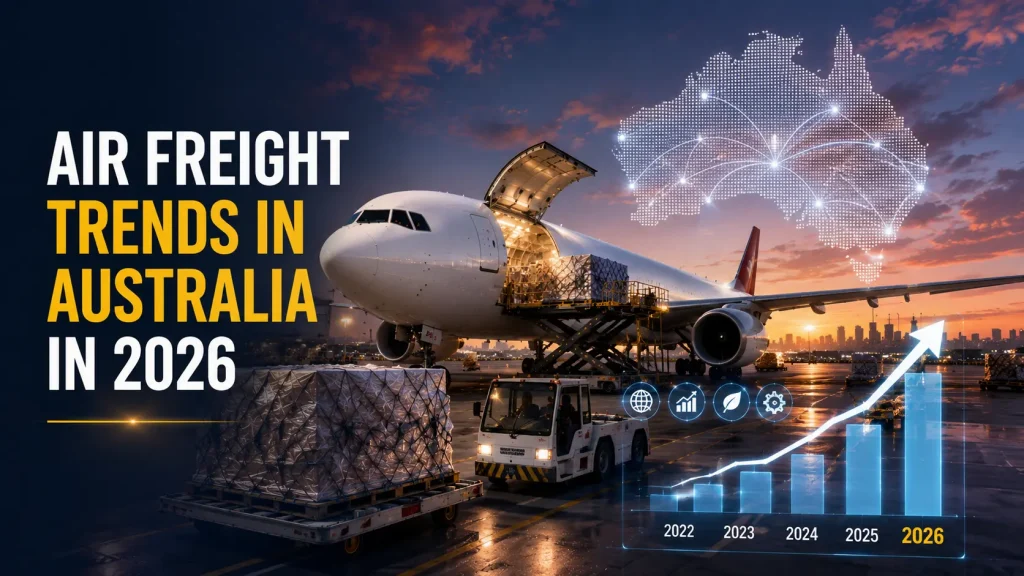
Australia’s air freight market is evolving. There are a number of trends that are influencing the industry today.
E-commerce is driving volume growth. The expansion of cross-border e-commerce, especially from China, is creating a huge extra demand for air freight. Companies such as Shein, Temu and Alibaba have established a massive stream of smaller, individual parcels which are being delivered by air. More than this, Australian consumers are driving this growth when purchasing goods directly from overseas.
Passenger belly capacity is recovering. Prior to Covid, a large volume of international air freight was transported in the ‘belly’ of the passenger aircraft. With the collapse of passenger traffic in 2020, the belly capacity was effectively eliminated and air freight rates jumped significantly. Belly capacity has been restored as has passenger usage, easing the normalisation of air freight rates. However, on many routes, rates are still above pre-pandemic levels.
Sustainability pressure is growing. Airlines are also making investments in new more fuel efficient airplanes and in sustainable aviation fuel (SAF) as part of their decarbonisation strategies. A few airlines are now providing verified carbon offset or SAF shipping options. As a result, the selection of the carrier to supply the business with business services now is taking increasing account of an emissions dimension, for companies with sustainability commitments.
Dedicated freighter capacity is expanding. A number of carriers have added special freighter services in and out of Australia and increased capacity and schedule flexibility. This is especially true for large or temperature-sensitive goods which cannot be transported in the passenger compartment of an aircraft.
Security requirements continue to tighten. Since 2010 the security requirements for air cargo have been increasingly stringent. Cargo services are easier to access by businesses.Businesses with known consignment have easier access to cargo services. Therefore, it is advised that businesses that are shipping goods regularly via air should apply for a known consignor status.
Frequently Asked Questions
What is air freight?
Air freight refers to the air movement of commerce goods. It is the quickest mode of international freight available and is suitable for time-critical, high value, perishable and/or higher security than sea freight offers.
How long does air freight take from China to Australia?
Air freight transit time from China to Australia is generally 3-5 days, depending on the airport the freight will be sent from, the flight path, and the destination airport within Australia. A faster, but higher cost option is express courier services, which can be two or three days quicker.
How much does air freight cost in Australia?
Air freight rate is subject to the chargeable weight (the maximum between actual weight and volumetric weight), the route and the market conditions. Cargo rates from China to Australia for general cargo are about $4 to $8 per kilogram without any customs clearance and delivery fees. Express courier services come with a much greater price tag.
What is volumetric weight in air freight?
Volumetric weight is a calculation that is used by airlines to determine the space a shipment requires on the plane, not its physical weight. The volume in cubic centimetres is divided by 6,000. Where the volumetric weight exceeds the actual gross weight, then the freight rate is charged on the volumetric weight.
When should I use air freight instead of sea freight?
The choice of air freight is appropriate whenever there is a premium on freight costs and the cost of delay is greater than the freight cost premium for time-critical inventory, high-value items, perishables, urgent spare parts, or items with fixed delivery dates. Sea freight is nearly always cheaper for bulk, heavy and non-urgent goods.
Can pharmaceuticals and temperature-sensitive goods be shipped by air to Australia?
Yes. Pharmaceuticals, vaccines and other temperature-sensitive products are frequently transported by air. Specialist handling, however, is needed, such as temperature controlled storage at the airport, specialist packaging, and temperature monitoring – data loggers. In addition, the pharmaceuticals products must meet the TGA Good Distribution Practice guidelines.
What documents are required for air freight into Australia?
Air freight import standard documents include commercial invoice, packing list, airway bill and certificate of origin. Also, some products are subject to import documents such as import permits, health certificates, phytosanitary certificates or other product-specific documents depending on the product and origin country.
What is a known consignor in air freight?
A ‘known consignor’ is a business that has been evaluated and endorsed by the Australian Border Force as compliant with security standards for air cargo. Some air cargo services for known consignors are more efficient than non-approved business. For companies that deal with regular air freight, this status is worthy of pursuing.
How FR8WISE Supports Air Freight in Australia
The FR8WISE supply chain team supports Australian businesses to manage air freight within an integrated logistics solution.
There is no one alone who makes the decision about air freight. They relate to inventory management the amount of safety stock to keep in order to not require emergency air freight. They link to supplier management the reliability of the supplier’s lead times and whether or not that reliability is worth sea freight. They relate to demand planning, whether or not peaks in demand can be forecasted and stock can be pre-positioned, thereby avoiding the need for costly last minute air shipment.
FR8WISE explores such linkages. We also assist businesses in determining the situations where air freight makes real sense, and when it is overpriced. Additionally, we assist businesses in the establishment of air freight services (via suitable carriers and freight forwarders) at negotiated rates, so that if a business needs air freight, it can be provided promptly and cost effectively.
In addition, businesses looking for a wider range of strategic advice on the design of international supply chains and trade planning can access Think Global Logistics (TGL) specialist advice around the complete international logistics and trade strategy landscape.
From a single urgent shipment to a systematic air freight programme, FR8WISE can help your business ship with greater success.