

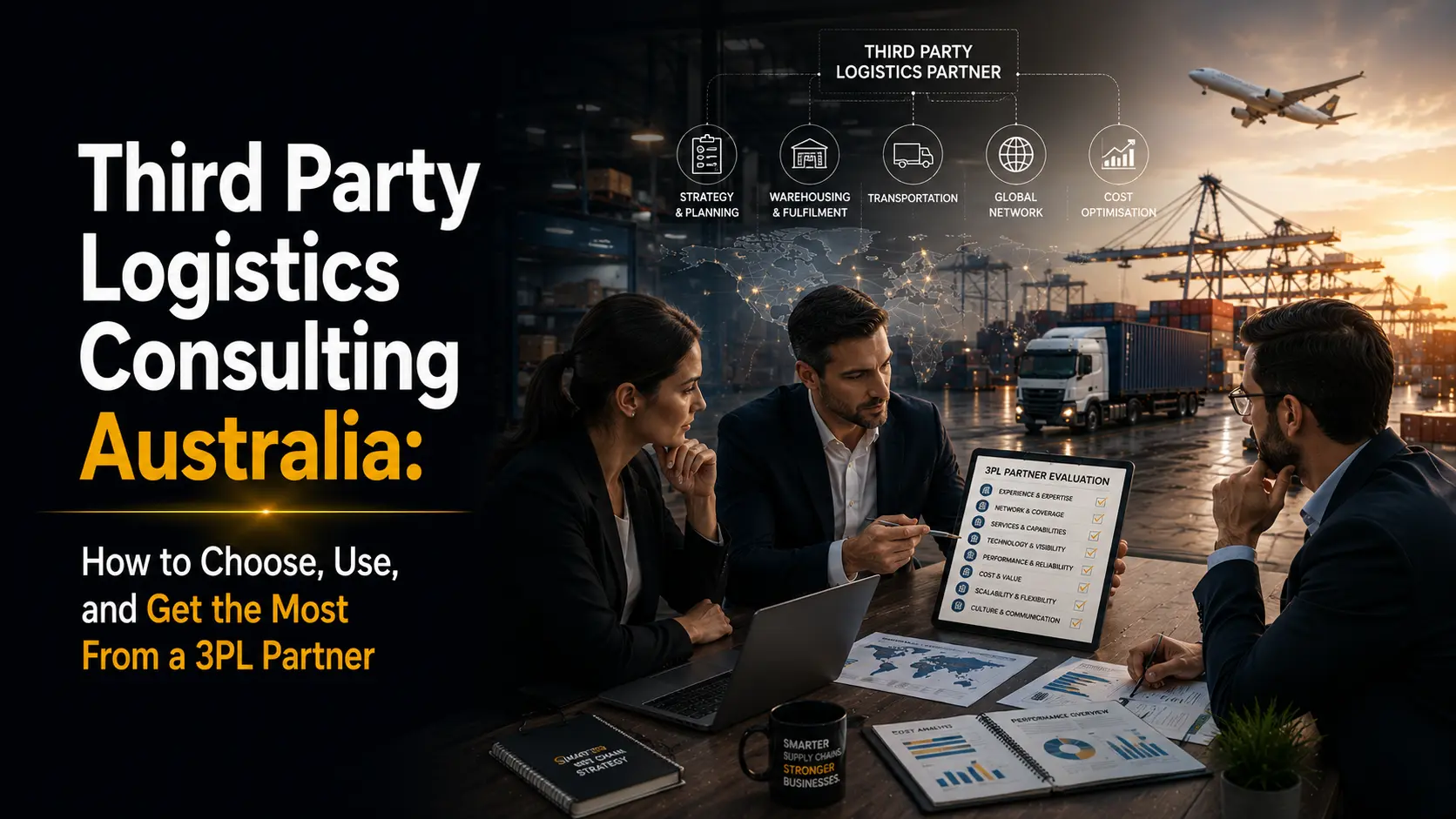

Written by the FR8WISE Supply Chain Team | FR8WISE is a Sydney-based supply chain consultancy working with Australian businesses across 14 industries to improve logistics operations, 3PL selection, and end-to-end supply chain performance.
The idea of outsourcing your logistics seems like a no-brainer. Turn over the warehouse. Have someone else pick and pack. Keep business in mind.
But in reality, it’s not quite as simple as it sounds.
If the 3PL isn’t the right one, it’s more expensive than doing it in-house. Service levels drop. Inventory accuracy suffers. The technology promised but never arrived. Changing six months into the future is costly and complicated.
Third party logistics consulting Australia can help businesses to prevent these errors. It aids them in selecting the appropriate 3PL partner. It aids in structuring the contract appropriately. It assists in effectively managing the relationship. And it brings the operational improvements you’re supposed to get from outsourcing.
This guide is for individuals interested in learning what third party logistics consulting entails. Understanding the work of 3PLs in Australia. Outsourcing when it is appropriate. Then how do you get it to work after you’ve decided to do it.
What Is Third Party Logistics (3PL)?
Third party logistics, or 3PL, involves outsourcing logistics activities such as warehousing, order fulfilment and shipping to a third party provider who specializes in logistics.
In a nutshell, your 3PL can hold your inventory, pick, pack, and ship your orders to your customers. You send them inventory to their wire house. They take care of all the rest.
But the range of what 3PL services encompass is dependent on each provider. Some provide simply basic ware housing and despatch. Others extend their service far beyond just customs clearance and returns management, to customs clearance, returns management, freight forwarding, inventory reporting, and integration of Supply Chain technology. Therefore, the key to selecting the right 3PL is to know exactly what your business requires. Not only the lowest price.
The 3PL market in Australia is growing and substantial. The demand is being created by the growth of e-commerce, warehousing costs and the complexity of omnichannel retail. In many cases, businesses that opt for outsourcing their warehousing needs to a specialist provider can save on the cost of establishing their own warehouse as well as the cost of maintaining it.
What Is Third Party Logistics Consulting?
Third party logistics (3PL) consulting is expert advice provided to Australian companies to determine if the company needs to outsource logistics, choose the appropriate 3PL logistics provider, negotiate contracts and SLAs, and manage it and optimise the relationship over time.
Most businesses select their 3PL without the aid of a specialist. They obtain some estimates. They compare prices. They select the provider that appears to be a good deal. Then they find out — sometimes after signing a multi-year contract — that the 3PL is lacking in the technology integration they need. Or the services level the commitments that are too over-general to be enforceable. Or their shipping pattern is negatively affected by the pricing structure in a way that they did not expect.
Third party logistics consulting can do that. A specialist consultant aids businesses to clearly establish their needs before entering the market. They compare 3PL bids on a ‘like-for-like’ basis. They negotiate contracts that really serve the business’s best interests. They facilitate the transition to a new job. And they expect the 3PL to deliver performance over the long term.
In addition, third party logistics consulting services are helpful not only in the selection process. There are lots of businesses that ask the consultants to analyze the present 3PL relationship which isn’t working. Or to renegotiate a contract at renewal. Or to oversee a change over from one 3PL to another.
How 3PLs Work in Australia
In Australia, 3PLs have warehouses, usually located in an industrial zone near major ports and distribution centres, where they hold stock for their clients, receive orders and then dispatch stock to their customers through their carrier network.
Knowing what happens in a 3PL helps businesses ask questions that lead to a better understanding of the process and the expectations to be held for outsourcing.
Receiving and Inbound Logistics
The stock needs to be received, checked, counted and put away when it arrives at the 3PL’s warehouse. This sounds straightforward. But inbound processes can be quite the problem. When stock is received with a wrong count, wrong label or out of place, there are downstream problems. Inventory inaccuracies. Fulfillment errors. Stockouts. A good 3PL has robust inbound processes. They acknowledge receipt of the order. They scan and record each item. They notify about discrepancies in a timely manner. Ask 3PL to be specific when assessing inbound processes and their error rates.
Warehousing and Storage
The 3PL stores your inventory in their facility. You might have a specific area your own part of the warehouse. Or used in common with other client’s goods. This will depend on the set up.
There is a charge for storage per pallet per week, per cubic metre or per SKU. It is important to grasp the pricing structure. For a company with 50 fast moving SKUs, a model that works well may be costly for a company with 500 slow moving SKUs.
Order Fulfilment
The 3PL selects the products, packs them, prints the label and sends the parcel while the customer orders. There is a time management aspect; both speed and accuracy are important.
The majority of 3PLs have a ‘cut-off’ period for same day despatch, normally at 2pm or 3pm. The orders placed before the cut off date are processed the same day. Orders after cut-off go the next business day. If you understand your customers’ location and what you are promising them for delivery, you can figure out whether or not a specific 3PL’s cut-off time is going to suit you.
Returns Management
In some product categories, online return rates in Australia can be up to 30% – 15%. A 3PL with good return services provides a valuable service. Receiving returned goods. Assessing condition. Restocking or disposing of appropriately. If a 3PL does not manage returns properly, it leaves them with an inventory backlog, incorrect inventory, and disgruntled customers.
Returns management is a process that is often overlooked when considering 3PLs. Therefore, check with prospective 3PLs for specific answers on how they return goods. So what is their turnaround time? What is the accounting treatment for stock that is returned?
Technology and Integration
The technology backbone of any 3PL’s operation is known as their Warehouse Management System (WMS). It handles inbound, outbound, picking, packing and despatch. It also produces inventory reports and order status updates that your business needs.
The majority of 3PLs have third-party integration with the likes of Shopify, WooCommerce, or Magento and marketplaces like Amazon and eBay. But the depth and reliability of these integrations is quite variable. A bad integration equals manual data entry, inventory discrepancies and late order updates. Therefore, before entering into a contract, test the technology integration – don’t just promise it.
When Does Outsourcing to a 3PL Make Sense?
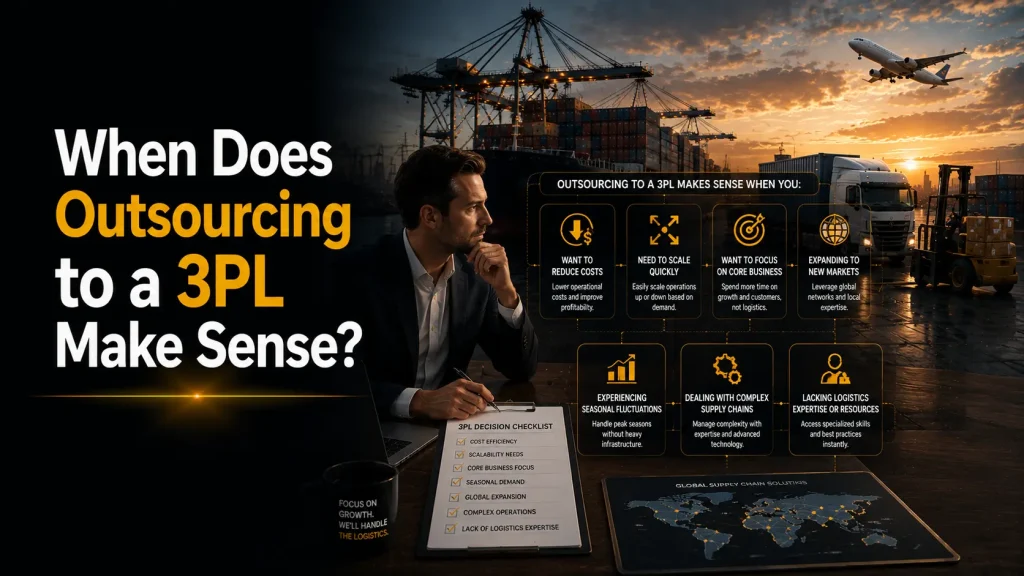
Outsourcing to a 3PL is a good option where the cost of in-house warehousing and fulfilment is more expensive than a 3PL would charge, when the business is not capable of looking after its logistics and supply chain operations, or when the complexity of logistics operations is increasing at a faster pace than the business’ in-house capability.
Not all businesses need to outsource logistics. In-house fulfilment may be the best option for some. Especially in terms of brand experience, product handling, or operational control. But, for many Australian businesses, outsourcing offers definite benefits when the time comes.
Volume has reached a threshold.For lower volumes in-house fulfilment makes sense. The economics change as the volume of orders increases. A 3PL operating at scale is cost competitive, compared to most businesses’ ability to achieve in-house. Once a 3PL becomes the most economical choice is a threshold that varies, but is generally reached at 50 to 200 orders a day.
Warehouse space is a constraint. The cost of finding and leasing warehouse space in Sydney, Melbourne or Brisbane is high. This is what a 3PL solution eliminates. Moreover, 3PL can increase or decrease the space allocation according to the changes of stock. It’s not easy when you are stuck in a leasing arrangement.
The business is expanding geographically. When combined with a Sydney-based operation, a Melbourne 3PL can help to shorten delivery times and freight costs. Not requiring the business to maintain two warehouses in concert.
Logistics is taking too much management attention.If management and/or founders are spending a lot of time operating the warehouse, logistics has moved beyond its setup. By outsourcing to a 3PL, that time can be used for more valuable work..
Peak season is overwhelming in-house capacity. Black Friday and Christmas can be a tough time for a warehouse that’s doing well otherwise. A 3PL with elasticity to capacity takes up the peak season. Without the need of the business to hire, train and manage temporary staff in the warehouse.
How to Choose a 3PL in Australia
Selecting the right 3PL in Australia involves a systematic approach that includes identifying needs and requirements, assessing providers based on standardized criteria, comprehending pricing structures, and testing and validating technology integration before finalizing the selection.
It’s here that the value of third party logistics (3PL) consulting really shines through. A formal quote comparison process always yields better results than an informal one.
Define Your Requirements First
Finally, before you reach out to 3PLs, determine what you really want. What is the rate of orders per day? How many SKUs? What is the mean of the data for the average size of an order? How many temperature or handling requirements does your product have? What tech supports do you require? What service level agreements (SLA) do you need to commit to customers?
If the requirements are not clearly defined, it is not possible to compare 3PL offers on a ‘like-for-like’ basis. There are multiple providers who will have various assumptions. The quotes will be unmatched.
Evaluate More Than Price
Price is important. However, it’s rarely the most important factor. A 3PL that costs 10% less, but takes longer to return products, has poor e-commerce integration, and has poor customer service will cost more in the long term. Assess 3PLs in person, tech savvy, service level promises, experience, references, financial strength and cultural integration.
Understand the Pricing Model Completely
3PL prices in Australia usually incorporate pick and pack charges, minimum month to month charges, returns dealing with charges, storage charges, despatch charges, and receiving charges. It’s crucial to familiarize yourself with how these affect your particular ship load profile. What may appear to be a low-cost option in the proposal can be a high-cost option in reality if your shipment profile doesn’t match the assumptions in the proposal.
Test the Technology Integration
Ensure that your ecommerce platform integrates with the 3PL’s WMS before entering into a contract. Does in-the-moment inventory updates? Is the flow of order statuses correct? Do notifications for dispatch go through reliably? One of the most frequent disappointments of technology integration is when the technology that looks great in a demo doesn’t work in production. This is avoided by using actual orders to test.
Check References
Request references from clients who have their same type of order volume, product category, channel mix. The ideal 3PL for a high-volume FMCG brand may not be the same as the ideal 3PL for a fashion brand with a complicated returns policy and large amount of SKUs.
Managing a 3PL Relationship in Australia
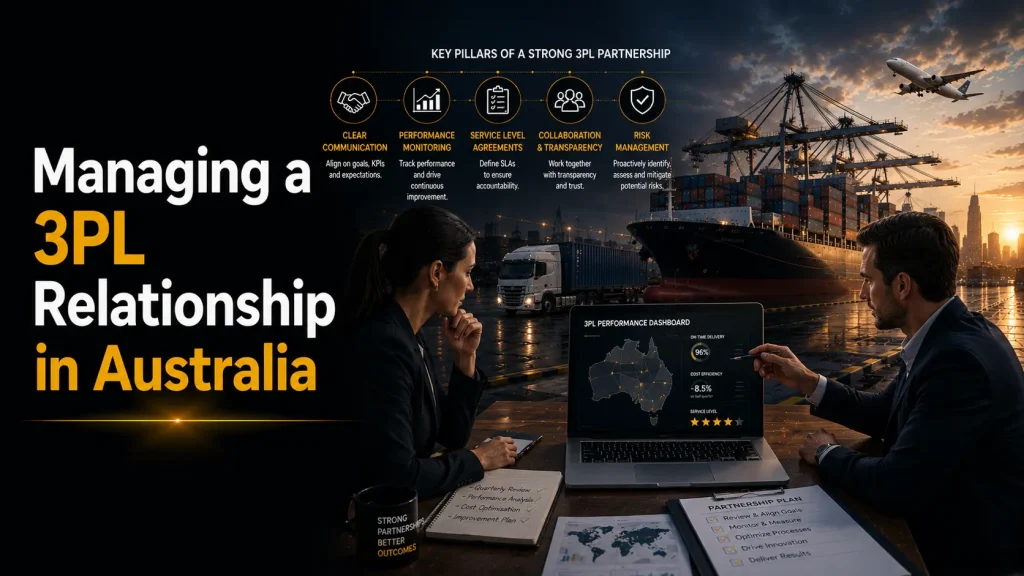
To have a good relationship with a 3PL, there needs to be a clear performance metric, regular reviews, good communication processes, and a willingness to escalate and solve problems swiftly when they occur.
The signing of a contract is just the first step. The value of the relationship is what makes or breaks the success of outsourcing.
Set Clear KPIs From the Start
Set up performance indicators in the beginning. Order accuracy rate. On-time dispatch rate. Inventory accuracy rate. Returns processing time. Inbound receiving time. Weekly/monthly reporting and review in performance meeting. It’s hard to see if there is a problem in performance metrics if there are no clear KPIs. It’s even more difficult to hold the 3PL accountable when they do.
Communicate Proactively
Treat the 3PL as a business partner and not as a service provider. Provide details about upcoming promotions. New product launches. Seasonal volume expectations. Product modifications or packaging. If a 3PL is caught off guard by the surge in volume, it will not do as well as a 3PL who is warned of the surge and has time to prepare.
Review and Renegotiate Regularly
The duration of a 3PL contract is usually from one to three years. Compare the contract at renewal to the market. Prices, service levels, technology features and requirements evolve over time. A contract that worked well three years ago therefore may not be current best practice.
Third party logistics consulting can be especially beneficial during renewal. A consultant having the current market knowledge can review the existing arrangement and confirm if it is a renegotiation or retendering that will be suitable.
Frequently Asked Questions: Third Party Logistics Consulting Australia
What is third party logistics (3PL)?
Third party logistics (3PL) describes the outsourcing of warehousing, ordering and delivery services to a third party specialist. The 3PL keeps your stock, orders picking and packing and delivers to your customer.
What is third party logistics consulting?
Third party logistics consulting helps businesses determine which logistics services to outsource, choose the right 3PL provider, design contracts and service level agreements (SLAs) to fit the business, manage a transition to the 3PL, and maximize the 3PL relationship with the business over time.
When should an Australian business use a 3PL?
The 3PL is likely to be a wise choice when: fulfillment is becoming increasingly expensive or time consuming in-house, space is an issue, growth is expanding beyond geographical boundaries, peak season is creating a strain on internal capacity, or logistics is taking too much time out of business operations.
How much does a 3PL cost in Australia?
The price of 3PLs can differ from one to another and from one service to another. Common cost factors are receiving fees, storage fees in pallets/month, pick and pack fees per order and item, despatch fees and return processing fees per return. Most 3PLs also have a minimum monthly fee requirement. Cost can only be realistically gauged with a detailed quote for the individual volume and shipment profile.
What should I look for when choosing a 3PL in Australia?
The location and proximity to your customer base, ability to integrate with technology, service level commitments, experience with your product category, transparency on pricing, financial stability, and customer references with similar business profiles.
How do I manage a 3PL relationship effectively?
Establish KPIs right away, check performance frequently, communicate proactively about any anticipated volume reductions or new product releases, and resolve problems promptly, before it grows out of hand. Treat the 3PL as a business partner, not a commodity service provider.
Can FR8WISE help me switch from one 3PL to another?
Yes. For businesses undergoing a transition between 3PL providers, FR8WISE offers support for the entire transition process, ranging from transferring stock to integrating technology, documenting processes, and managing onboarding throughout the transition to help minimize disruption.
How FR8WISE Supports Third Party Logistics Consulting in Australia
The FR8WISE supply chain team offers 3PL consulting services throughout the 3PL lifecycle. Starting from the level of evaluation until selection, onboarding, and performance management and renewal of the contract.
The ability to provide strategic advisory coupled with operational depth is what makes the approach of FR8WISE unique. Have run warehouse operations. We have negotiated 3PL contracts. We understand what will be considered good performance. We also know the signs that you are experiencing a bad 3PL relationship.
The FR8WISE 3PL Consulting Services are:
3PL needs assessment. A detailed assessment of the existing logistics processes. Deciding if outsourcing is appropriate, what your needs are and what kind of 3PL provider can fulfill them.
3PL market evaluation. Taking your requirements to the market. Comparing proposals from several companies. Creating a comparative analysis that clearly makes providers’ offerings easier to understand.
Contract negotiation support. A contract review to uncover negative terms of 3PL contracts. Discussing service level arrangements and penalties. Making sure that the contract is protecting your interests.
Transition management. Overseeing the onboarding process, including stock transfer, technology integration, documentation and training. Minimising disruption and ensuring the 3PL is set-up for success from day one.
Performance management. Creating KPI frameworks, performance reviews, and escalation processes when the level of service does not reach the commitment.
Contract renewal and retendering. Comparing and benchmarking existing 3PL agreements with the market when they expire. To support the re tender process where appropriate.
Think Global Logistics (TGL) provides specialist consulting for the complete picture of the supply chain, going beyond 3PL management to freight forwarding, customs compliance and procurement strategy for businesses that require it for broader strategic supply chain support.
Whether this is your first time considering a 3PL, you’re experiencing poor performance from your 3PL, or you’re approaching the end of your contract — FR8WISE has the expertise to assist you.