


Written by the FR8WISE Supply Chain Team | FR8WISE is a Sydney,based supply chain consultancy working with Australian businesses across 14 industries to improve logistics performance, freight operations, and supply chain strategy.
Australian logistics is on the verge of transformation. And most businesses are not aware of how fast it’s going.
Now, AI in logistics is being discussed in conferences by the big players a few years ago. Amazon. DHL. FedEx. Not an issue for mid/sized Australian importers and retailers.
It’s no longer so.
Many Australian companies are already leveraging AI for route optimization, demand prediction, labor management in warehouses, customs clearance, and supply chain risk management, among other applications.Australian businesses of all sizes are increasingly harnessing the power of AI for optimization, demand forecasting, warehouse automation, customs processing, and supply chain risk management, just to name a few. This has led to companies that are aware of the potential of AI and are adopting it first to gain a true competitive edge over those who are not.
This guide provides an overview on the practical aspects of AI in logistics australia. The products currently in use in Australia. What the actual advantages are. And how organisations can begin to leverage AI to boost supply chain performance without hiring a tech team.
What Is AI in Logistics?
AI in logistics is the application of AI technologies such as machine learning, predictive analytics, computer vision and natural language processing in logistics, enabling the automation of decisions, enhancement of visibility and optimization of performance in freight, warehousing, customs and supply chain processes.
It’s a broad term. So, it’s useful to disaggregate it into the specific applications that are in fact being used in the Australian market today.
AI in logistics isn’t a single technology. It’s a collection of capabilities used to solve particular logistics issues. Real-time route optimization software for optimizing delivery routes based on traffic and weather conditions. Demand forecasting tools which enable prediction of the stock requirement and time. Order picking and sorting robots that do not require human intervention. Inbound cargo screening systems for computer based inspections of cargo for damage or biosecurity threats. All of these are examples of applying AI to different problems in the logistics field.
Additionally, AI for logistics doesn’t have to be a specialty of big companies. Today, there are many platforms available to Australian businesses that are SaaS, cloud, hosted, and can be afforded by businesses with a relatively small technology budget.
Why AI in Logistics Matters for Australian Businesses Right Now
AI in logistics becomes especially significant for Australian businesses in 2026 due to several critical factors, including the increasing complexity of global supply chains, labor shortages in the logistics sector, and the necessity for businesses to report on their emissions.Key factors are the complexity of supply chains that cross multiple countries, channels and modes, the demand for businesses to report on their emissions and a shortage of labour in the logistics industry.
Meanwhile, driver shortages, higher warehousing costs and growing customer expectation for faster deliveries are impacting logistics costs for both Australian exporters and importers and becoming more challenging than ever without improved technology.
All these pressures are directly addressed by AI.
Cost pressure. AIdriven route optimisation helps minimise fuel consumption and kilometres driven. AI demand forecasting minimises excess stock and emergency air freight. AI freight procurement solutions uncover rate savings that would be missed using manual methods. These all directly translate to reduced operating costs.
Labour shortages. Automation enhances speed and flexibility in warehouse and transport and logistics processes, which help to minimize reliance on warehouse human resources that are more and more scarce and costly. Autonomous vehicles and delivery robots are being trialled in Australian cities. These are not the technologies of the far future, but they are available in some markets now.
Visibility and risk management. The whole challenge is to move past the reactive tracking of goods, and more towards predicting and orchestrating the supply chain. Now, businesses must be aware of where the trouble will happen — before it happens — in order to be able to act proactively, instead of reactively.
Emissions reporting. Many businesses in Australia now have mandatory reporting of Scope 3 emissions. This includes emissions from freight transport companies, logistics service providers and suppliers, which are also an important part of Scope 3. The use of AI solutions to monitor and work towards emissions reduction throughout the entire supply chain is thus no longer a wish but a must.
AI Applications in Australian Logistics Right Now
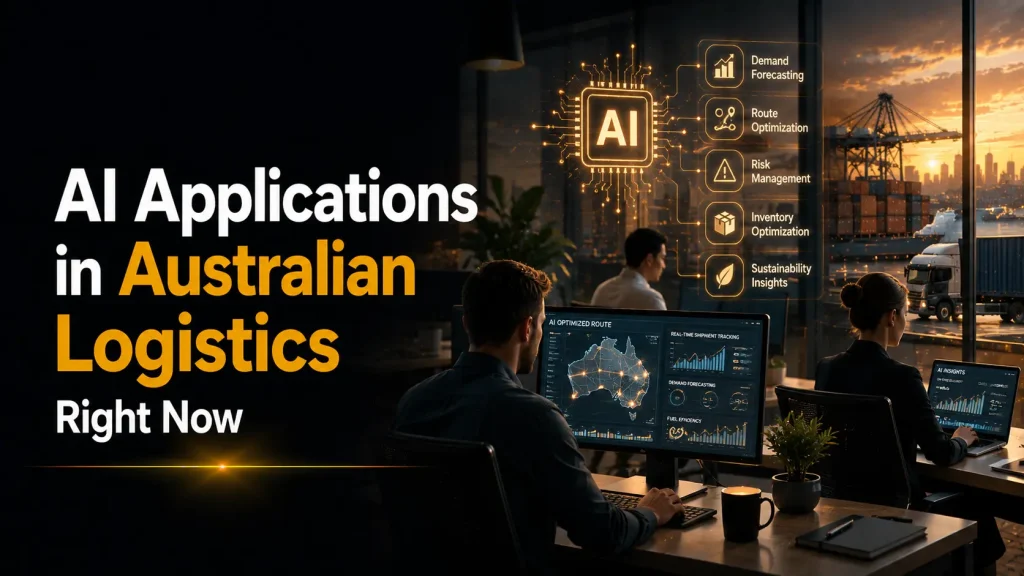
AI is being used in various aspects of logistics in Australia. Here’s what’s actually in use not what’s theoretical.
Demand Forecasting and Inventory Optimisation
That’s where AI is showing most immediate, clear value for most Australian businesses. The traditional approach to demand forecasting is based on past sales information and hand-coded seasonalities and promotions. It is time-consuming and can be erroneous.
AIpowered demand forecasting involves leveraging machine learning algorithms to analyse past sales data and external factors such as weather conditions, economic indicators, competitor actions, social media trends, and other data points. The outcome is predictions much more precise than manual techniques. As a result, companies have reduced safety stocks, fewer stockouts, and are able to release working capital tied up in excess inventories.
Accurate demand forecasting is also valuable to Australian businesses, especially those with long international lead times, where decisions must be made many weeks or months ahead of time. If a business imports from China and has a 6 week lead time, they should order something that they think they will be selling in 6 weeks – not last month. With the help of AI, that forecast becomes much more accurate.
Route Optimisation and Last Mile Delivery
Route optimisation software has been in existence for years. But AI has revolutionized its capabilities. Optimised route using modern AI does not simply work out the optimum route in the beginning of the day. It real-calculates traffic, weather, failed delivery, vehicle breakdowns, new orders etc in real time as they change.
This is good news for businesses in Australia that operate delivery fleets: fewer kilometres driven means lower fuel costs, more deliveries per driver per day and better on-time performance. AI-powered carrier selection tools for businesses that use third-party couriers match each shipment to the optimum carrier based on real-time performance data, rather than averages.
Moreover, AI is also being leveraged to predict and prevent miscarriage. AI tools can predict deliveries that are likely to be problematic based on patterns in delivery success rates across postcodes, time of day, and customer behavior, then provide proactive support measures before a driver reaches a customer door: customer notifications, checking delivery times with customers before they reach your door, advising on different delivery options.
Warehouse Automation and Robotics
One of the more prominent uses of AI in Australian logistics is known as warehouse automation. Autonomous Mobile Robots (AMRs) move on the warehouse floor without any fixed infrastructure and pick objects and carry them to the packing stations. Automated sortation systems can’t be outworked by human teams when it comes to processing returns and inbound shipments.
These systems are no longer restricted to big distribution centres. AMR deployments are now commercially viable to mid-sized businesses, with smaller deployments. Due to this, the economics of warehouse automation have changed hugely in the last 3 years.
AI also enables warehouse management systems to guide human workers in optimizing pick paths, dynamically re-slotting according to velocity data, and forecasting equipment maintenance needs before problems occur.
Freight Procurement and Rate Management
Rates are not set in stone. Carrier capacity fluctuates. Surcharges are added and subtracted. It’s important to keep track of the amount that should be paid and to make sure it is being paid, but it’s a big manual task.
AI enabled freight procurement platforms streamline this. They track rate benchmarks on different carriers, alert on contracted rates that exceed the market, look for consolidation opportunities, and create rate comparison analysis that would take hours to do by hand.
These platforms may even find that these platforms can save Australian businesses 10% to 20% on their total freight spend in the first year alone, if their businesses spend a significant amount on freight. Furthermore, they hold these savings in the long run by regularly scanning the market instead of checking it off at intervals.
Supply Chain Visibility and Risk Management
The traditional supply chain visibility is composed of information about the location of the shipment. AI powered visibility translates to knowing where problems are likely to occur before they actually do.
AI systems can monitor data from the entire supply chain, including carrier data, port congestion, weather forecasts, geopolitical risk factors, supplier financial data, and many others, then leverage machine learning algorithms to anticipate disruptions. A strike at a major transshipment port. An unsound company in financial trouble. An event that will cause a shipment to be delayed for at least 3 days.
The information allows businesses to take proactive measures. Rerouting shipments. Adjusting inventory orders. Prompt communication with customers. These are far less costly interventions than to respond to the disruption after it has happened.
Predictive visibility is one of the highest value AI applications available in the Australian market due to the length of supply chains and the impact of international disruption on the availability of products.
Customs and Trade Compliance Automation
Customs clearance is a document,heavy, ruleintensive process. It is undergoing automation with the help of AI to a great extent. OCR extracts data from commercial invoices and other documents without having to manually enter the data. The Harmonised System (HS) code classification is automated via machine learning, to minimize classification errors. Documentation pre-checking by AI tools ensures completeness and accuracy prior to lodgement and prevents errors that could lead to customs queries.
Customs automation helps businesses with regular imports to clear goods faster, lowers the risk of errors, and allows customs brokers to handle higher-value, more complex cases instead of routine ones.
Moreover, AI tools are starting to be adopted for automatic identification of FTA concessions, to ascertain if goods are eligible for reduced duty under Australia’s free trade agreements and to identify the necessary documentation. This is a space in which AI can bring direct monetary benefits due to the potential duty savings.
What AI in Logistics Means for Supply Chain Consulting
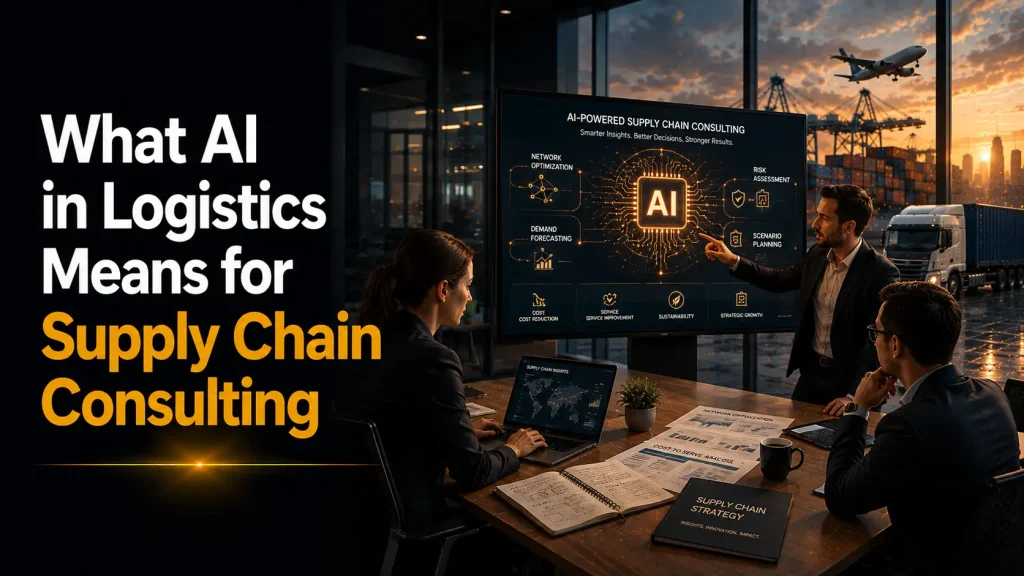
AI transforms the nature of good supply chain consulting. It also uproars the expectations of Australian businesses when it comes to logistics vendors.
An AI-naive supply chain consultant is not able to assist businesses with creating supply chains for a successful 2026 and beyond. On the other hand, a consultant who states all about AI but then has nothing to back it up with is just as useless.
The right way to do it is to regard AI as a set of powerful tools, nothing more. The question is not ‘should we use AI?’ It’s “which AI apps will provide the best ROI for this particular business, based on their existing processes, pain points, and resources?”
That analysis needs an advanced understanding of how freight markets work, warehouse operations, inventory management, customs compliance and demand planning, not to mention what and how much AI tools are available and what they actually provide.
Here’s what FR8WISE brings to AI for logistics consulting. We have put in place demand forecasting tools for importers into Australia. We have assisted businesses in assessing and picking WMS with AI,powered capabilities. We’ve employed freight procurement platforms to uncover savings in complicated carrier combinations. Our recommendations are based on experience in the field, rather than theory.
How to Get Started With AI in Logistics
In most cases, the first step for an Australian business is not a significant technology investment. A transparent, sighted evaluation of AI’s focus of value.
Start with your biggest pain point. When sales are being lost due to stock out, the priority is demand forecasting. When it is not possible to afford the cost of warehouse workers, robotics and automation should be considered. Freight procurement AI is a good place to begin if freight spend is increasing at a rate that’s higher than revenue. Look for 1 or 2 places where you could make a better decision, and work on those.
Use existing platforms before building custom solutions. In most cases, Australian businesses should leverage existing, AI,powered platforms that can provide planning tools, TMS platforms that are AI,powered, carrier selection AI,powered and WMS systems that have built,in optimisation features — instead of developing custom solutions. They’re better than the platform most businesses could develop, faster to deploy and continually enhanced by the platform vendor.
Measure the baseline before you start. Before using any AI tool, assess current performance (order accuracy, inventory turns, freight cost per order, demand forecast error). You won’t be able to tell if the AI tool is providing value unless you have a baseline.
Don’t underestimate change management. AI tools will change how people use the tools. Planners must have confidence in the output of the forecasts. The warehouse managers must adhere to system and directed pick paths. Freight managers must take action with regard to rate recommendations. The technology is often the simple bit. Consistently using it with the team is often more difficult.
Work with a supply chain consultant who understands both logistics and technology.It’s when supply chain knowledge meets AI capability that the true value comes in. A consultant with experience in freight, customs, and warehouse operations, who is also well-versed in the potential and capabilities of AI tools, can assist businesses in making more informed decisions more quickly.
How FR8WISE Supports AI in Logistics for Australian Businesses
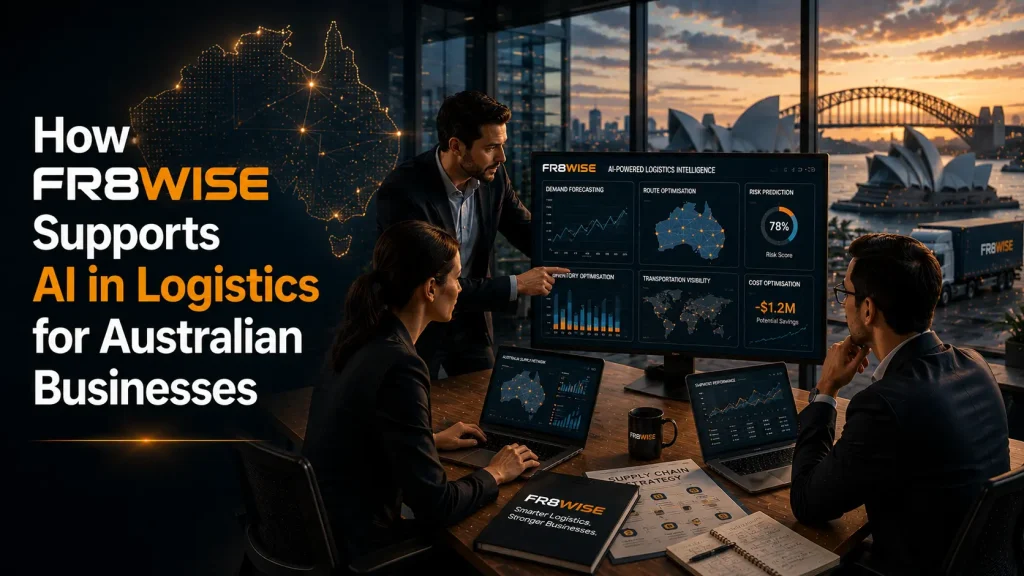
The FR8WISE supply chain team provides assistance for Australian businesses to understand, assess and adopt AI in their logistics workflow as part of an overall supply chain optimisation initiative.
We’re not in the business of selling tech. We assist businesses make effective choices regarding technologies, whether they are available, how they can be expected to perform and how they can be integrated into a supply chain that includes humans, processes and carrier relationships.
AI in logistics consulting services encompass a variety of applications, such as:
Technology assessment. Assessing the appropriate AI solutions for a company’s particular supply chain issues involves a nuanced grasp of what each solution actually achieves and offers, as well as forecasting, warehouse management, freight procurement, visibility platforms, and customs automation.
Implementation support. Setting up data feeds, defining baseline metrics, training teams, and measuring results to help businesses successfully deploy AI tools.
Integration with supply chain strategy. Implementing AI tools within a unified supply chain strategy, rather than as standalone technology initiatives, that aren’t integrated into the whole operation.
Think Global Logistics (TGL) provides specialist consulting across global logistics and trade strategy for businesses seeking a wider international supply chain strategy in addition to AI in logistics support.
If you’re trying to understand what AI in logistics means for your business, or looking to implement AI tools that actually deliver results FR8WISE is ready to help.
Frequently Asked Questions: AI in Logistics Australia
What is AI in logistics?
AI in logistics is the application of AI, machine learning, predictive analytics, computer vision and automation to enhance freight, warehousing, customs and supply chain decisions and performance.
How is AI being used in Australian logistics right now?
AI is being used in demand forecasting, route optimisation, warehouse automation, freight procurement, supply chain visibility, and customs clearance automation. These applications are available to businesses of all sizes, not just large enterprises.
Does AI in logistics require a large technology investment?
Not necessarily. Most of the AI,powered logistics platforms are cloudbased SaaS software with subscription fee which is available to medium and large businesses. The first step is to determine which application would be of greatest value, not to embark on a big technology program.
What is the biggest benefit of AI in logistics for Australian businesses?
This will be dependent on the business. AI demand forecasting provides the most significant benefits for importers with long lead times, in terms of minimizing stockouts and overstocking. AI-driven freight procurement uncovers savings for businesses that have a high amount of freight spend. For warehouse,intensive operations, automation and AI,powered WMS systems reduce labour costs and improve accuracy.
How does AI help with supply chain visibility?
AI-driven visibility tools don’t only let you know where shipments are, they also anticipate where issues might arise before they even occur. These tools can be used to analyse carrier performance data, congestion at ports, weather and geopolitical risk indicators, so that companies can take action rather than react.
Is AI in logistics relevant for small and mid,sized Australian businesses?
Yes. There are a lot of AI,powered platforms that are targeted specifically for businesses that don’t have the enterprise tech budget. AI for logistics is now available at virtually any scale through the Cloud Based tools that feature per,user or per,transaction pricing.
How do I get started with AI in logistics?
The first step is to find your biggest supply chain pain point. Next, consider which AI solutions can solve that problem. Before you do anything, measure how you’re doing right now! Also, collaborate with a supply chain consultant who knows logistics operations and supply chain technology to ensure you aren’t using tools you don’t need.
FR8WISE — Strategic Supply Chain & Logistics Solutions | Sydney, Australia