


Written by the FR8WISE Supply Chain Team | FR8WISE is a Sydney-based logistics and supply chain consultancy working with Australian businesses across 14 industries to improve freight operations, customs compliance, and end-to-end supply chain performance.
One of the most critical decisions in a business’ supply chain is selecting a logistics firm in Australia.
Make it the right one and goods are transported effectively. Expenses remain within budget. Customers receive that which they have requested at the time of their request. The supply chain is intended to provide for growth not to constrain it.
The issues escalate rapidly if the wrong is made. Delayed shipments. Unexpected freight charges. Unanticipated customs holds. A logistics partner who stays mum when things are getting tricky.
This guide discusses what to consider in Australian logistics companies, the various kinds of logistics providers, how you can determine the right one, and how to manage the relationship once you’ve decided.
What Do Logistics Companies in Australia Actually Do?
Logistics Australia comprises logistics businesses which handle the movement, storage and management of goods in Australia , whether independently or as a part of a comprehensive service, including freight forwarding, customs clearance, warehousing, order fulfilment and last mile delivery.
Logistics company can be used to refer to any number of providers. Others specialize in one service, such as freight forwarders, which are responsible for carrying goods internationally, 3PLs who are responsible for warehousing and fulfillment or couriers who deliver parcels to end customers. Some provide comprehensive services in a multi-function model.
The first step in choosing a logistics company is deciding on the kind of company you need, and what they really do. This means it’s important to draw up a supply chain mapping plan before contacting any supplier.
Types of Logistics Companies Australia
Australian logistics firms are divided into four groups: freight forwarders, customs brokers, 3PL logistics providers, couriers and parcel services and integrated supply chain providers.
Each type is for a different job. Understanding the contrast will assist organisations achieve the right provider for the right function.
Freight Forwarders
Freight Forwarders are responsible for transporting goods internationally. They arrange for space to be made available on a vessel or plane, organise their pickup from the supplier, export customs clearance at origin, arrange the documentation needed for export transport, and import customs clearance and delivery in Australia.
The freight forwarder is the backbone of the international leg of logistics for businesses importing from China, Southeast Asia, Europe or North America, and/or exporting to international markets, in Australia.
A good freight forwarder is more than just a freight booker. They provide advice on the best and cheapest route, look for concession opportunities for goods under free trade agreements that will limit duty payments, identify biosecurity requirements before goods leave port and handle exceptions when things go wrong during transit.
Customs Brokers
Customs brokers are authorised persons that prepare and lodge customs declarations with the Australian Border Force. They code goods to the Harmonised System (HS) code, apply applicable duty and GST, process FTA concession claims and liaise with the ABF throughout the clearance process.
Many freight forwarders provide customs brokerage service. But some companies use a customs broker separately – especially if the import programme is complicated, expensive or the subject of a considerable amount of regulation.
Third-Party Logistics Providers (3PLs)
A 3PL company is responsible for taking care of the company’s orders, warehousing and despatch. The client is responsible for providing inventory to the 3PL’s facility. The 3PL stores it, picks and packs it as orders are received and dispatches it via carrier networks.
3PLs are suitable for companies that have seen their own in-house fulfilment systems become too time consuming and resource-intensive to do for them. A good 3PL can offer the ability to manage carrier relationships, the infrastructure to store goods and services, and the expertise to operate these services – something most businesses cannot do efficiently and cost-effectively on their own.
Courier and Parcel Services
The last mile delivery of parcels to an end customer or business address is done by Courier Companies such as Australia Post, Sendle, Couriers Please, Aramex, TNT and DHL Express. They run local and global networks and connect with online shopping carts to create and track labels automatically.
The Courier Relationship is the most visible aspect of the logistics process to the customer in E-Commerce. “Customer experience” is whether or not the parcel was delivered, in good condition and in the right location.
Integrated Supply Chain Providers
Integrated logistics services are available in Australia from some freight companies, which include logistics services like freight goods forwarders, customs clearance, warehousing, and delivery as a single package. It will cut down on the number of relationships with providers to manage, and it will help information to move from function to function instead of disappearing between different companies in handoffs.
FR8WISE is a one-stop partner for the whole supply chain; freight forwarding, customs compliance, warehouse optimisation, procurement strategy and supply chain consulting are all done from a single team and a single view of the operation.
What to Look for in Australian Logistics Companies
When considering logistics companies in Australia, the key elements that are important to take into account are industry experience, network reach, technology competency, customs and compliance knowledge, communication quality, and clear pricing.
These are the factors that distinguish the logistics partners who do the job well from those who look good on paper and provide poor service once you sign.
Relevant Industry Experience
The needs in the supply chain vary widely among industries. A logistics company with a deep expertise in pharmaceutical distribution knows about TGA compliance, cold chain requirements, and the requirements for pharmaceutical imports documentation. Someone who has food and agriculture experience is familiar with the requirements for biosecurity, phytosanitary certificates and the time sensitivity of perishable products. A miner with experience in resources knows project freight, heavy lift and remote delivery.
You have no way of knowing how an inexperienced logistics company will perform on your shipments. That’s a price you pay in delays, in errors and in the time your team will be spending on problem management issues that an experienced provider would have thought of.
Network Coverage
If you are importing or exporting goods to or from Australia, the network of the logistics company should include the trade lanes you utilize. If a business primarily operates along China, Southeast Asian and European routes, it is best suited to hire a freight forwarder that has solid ties in all three locations. For another trade profile, one with a strong coverage of North America and the Middle East is just right.
Network coverage on the domestic front is the ability to reliably deliver to your key customer locations, including areas of the country where not every carrier provides consistent coverage.
Technology Capability
Digital integration is a must in modern logistics. Real-time shipment tracking. Electronic documentation. Seamless integration with the logistics provider’s systems, ERP, or order management system/e-commerce platform. Automated alerts for important shipment stages.
If a logistics company is still doing manual documentation, doesn’t update you on the logistics tracking unless you ask, and can’t connect with your systems, then it isn’t operating at the level of good supply chain management. Additionally, mismatched technologies cause data gaps, resulting in problems with inventory, orders, and customer service.
Customs and Compliance Expertise
Customs compliance is a requirement for Australian importers. Inaccurate tariff classification, failure to claim FTA concessions, improper packaging, or incomplete documentation all can cause costly issues. It is important that the logistics company has customs knowledge whether they have their own or have a partner customs broker who is known and trusted.
Inquire: Do they have their own licensed customs brokers? What do they do if they come across a product that is not in their experience or has a complicated tariff classification? Do they proactively seek out FTA concession opportunities or do they rely on the client to do that? What do they do about biosecurity compliance?
Communication Standards
The thing most people complain about logistics companies about is that things go wrong , logistics companies, all supply chains experience things going wrong. The issue is the lack of proactive communication of problems.
It’s worth so much more to have a logistics partner who tells you about a problem before you even have to query them about an update. Have questions regarding exceptions to the provider. What do they do if their shipment is late? Who do they reach out to, how fast and what information?
Transparent Pricing
Logistics price is complicated. Base freight rates. Fuel surcharges. Security levies. Destination handling charges. Customs broker fees. Storage fees. Peak season surcharges. If the provider has a competitive base rate but then adds surcharges that weren’t mentioned at the start, it’s not being transparent in its pricing.
Before you compare providers, request a complete breakdown of the costs, including any fees that may apply to a typical shipment. Paper quotes are not necessarily the lowest quotes.
How to Evaluate Logistics Companies in Australia
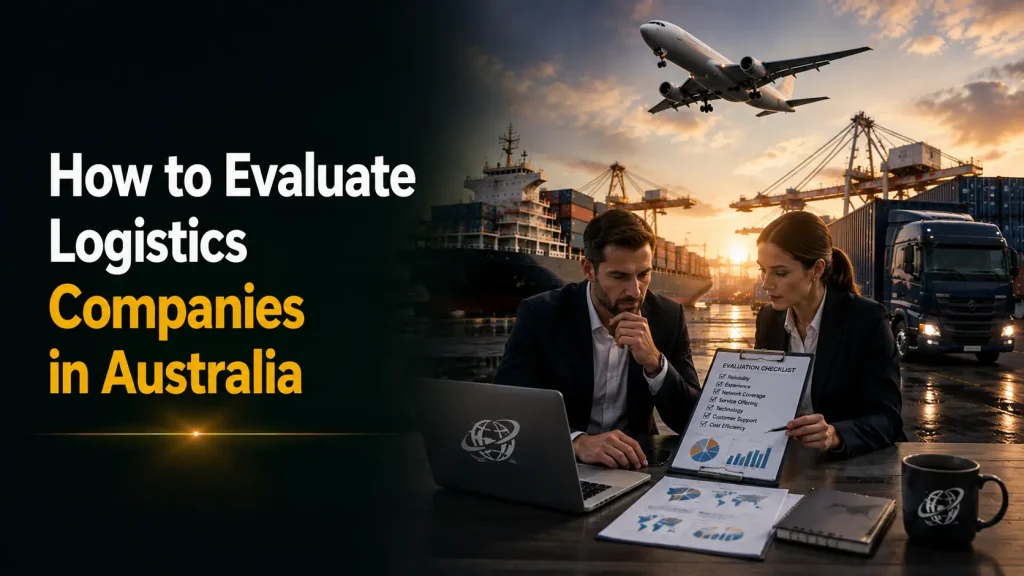
When looking at logistics companies in Australia, it is important to have a systematic approach, including clearly stating the needs, constantly asking for proposals, checking references, and testing the relationship prior to a long-term contract.
Many companies base their selection of logistics companies on a discussion and a cost. This practice always has poorer results than a structured assessment.
Define Your Requirements First
Make sure to write down your requirements before contacting any logistics company. What are your major trade routes? How much does the volume move? What are the product types and are there any unusual handling/compliance issues? What technology supports do you require? What level of service do you have to meet for your customers?
If there are no requirements, it is not possible to compare proposals. The quotes won’t be comparable and different providers will make different assumptions.
Request Proposals Consistently
Submit the same package of requirements in a short letter to several providers. Request a quote from the same one-time shipment. Repeat the questions regarding technology, compliance ability and references. This establishes a benchmark for comparison and helps to ensure that providers don’t design their proposals simply based on their strengths, rather than yours.
Check References
Request references from businesses having similar trade characteristics , similar industries, trade lanes, volumes. What works well for a high volume retailer importing from China might not be appropriate for a pharmaceutical importer from Europe that has complex compliance needs.
Speak with the references. Don’t ask the logistics company about the way things go when they go well, ask them how things go when they don’t go well. The answer gives you much more information about the true level of service.
Test Before Committing
If it’s feasible, consider conducting a trial before making a long-term investment. Test a couple of shipments through the new provider and check their actual performance and not its promised performance. Especially on warehousing and 3PL arrangements, where changing providers midstream can cause disruption and be expensive.
Common Mistakes When Choosing Logistics Companies in Australia
These problems are often encountered. Most can be prevented if one prepares properly.
Choosing on price alone. The lowest-cost logistics firm is not always the most cost effective. There are costs associated with hidden surcharges, service recovery issues, compliance issues, and slow clearance time that aren’t included in an initial quote.
Not checking compliance capability. The companies that find their logistics partner’s customs compliance problems are often after these issues have been identified by a customs hold or an ABF audit. This can be avoided by verifying compliance capability in advance as this involves checking if they have customs brokers and if so, how they deal with tariff classification.
Ignoring technology integration. You can’t work with a logistics supplier that does not integrate with your systems, or you will get the need to enter all data manually and you will create data gaps that lead to mistakes down the road. Before committing to technology integration, test it out; don’t assume it will work.
Single-provider dependency.Having all your freight carried by one logistics provider makes things a single point of failure. If that provider experiences capacity constraints, system problems or service quality degradation, it will impact all shipments. Resilience is achieved by using a multi-provider approach (one primary provider, and one or more qualified backup providers).
Not reviewing the relationship regularly. Logistics markets change. Carrier rates fluctuate. Provider capabilities evolve. Three-year-old competitive and efficient logistics may not be the same as today. The relationship is made honest by regular performance reviews and periodic market benchmarking.
How FR8WISE Supports Australian Businesses with Logistics
FR8WISE is a Sydney based supply chain and logistics consultancy providing services to Australian businesses in 14 industries. FR8WISE is not a normal logistics company, it offers strategic consulting skills, as well as logistics skills.
This does not only involve carrying goods, we help businesses be aware of how their logistics needs should be organised, where it is not performing up to scratch and how to improve it. Duty savings are identified as part of FTA concession management. Freight cost reductions are achieved by renegotiating with carriers and optimising the network. We optimize the warehouse process by improving the slotting process and the choice of warehouse technologies. And we develop supply chain resilience by diversifying the suppliers and planning contingencies.
Our logistics services cover the full supply chain:
Freight forwarding. Sea freight (FCL and LCL), air freight, multimodal freight and project cargo on all major trade lanes – China, Southeast Asia, Europe, North America, India and more.
Customs clearance. Licensed customs brokers, who have an extensive understanding of Australian customs regulations, handle import declarations, tariff classification, FTA concession management, biosecurity compliance and export documentation.
Smart procurement. Supplier identification, contract negotiation, performance management and risk diversification – assisting companies to source more effectively, and to manage their supplier relationships more professionally.
Warehouse optimization. Warehouse auditing, optimisation of slotting, selection and implementation of WMS, improving inventory accuracy, selection and management of 3PL.
Supply chain consulting. Assessment of freight costs, development of an improvement roadmap, technology analysis, and emissions baseline measurement for Scope 3 reporting.
Think Global Logistics (TGL) provides specialist consulting, covering the whole picture of the international supply chain, for businesses with a wider international trade strategy, as well as day to day support, such as global network design, trade lane optimisation and planning for market entry.
Whether you are considering changing your current logistics solution, shopping around for a new provider, or you want to create a new and improved supply chain , FR8WISE is something to consider.
Frequently Asked Questions
What do logistics companies in Australia do?
Australia logistics companies are responsible for the transportation, storage, and handling of goods. Services range from freight forwarding, customs clearance and warehousing, order fulfilment to last mile delivery, either as standalone or as part of an integrated service, depending on the type of provider.
What is the difference between a freight forwarder and a 3PL?
A freight forwarder arranges international freight movements, including booking, documentation and customs clearance. A 3PL is responsible for the storage of goods, picking and packing orders and despatching goods to customers. Many businesses are using both, with the freight forwarder taking care of the international part, and the 3PL the domestic part, which involves storage and fulfilment.
How do I choose a logistics company in Australia?
Be clear about what you’re seeking from providers. Do not just review freight rates, but also evaluate on industry experience, network coverage, technology capability, customs compliance experience, communication standards and transparent pricing. Verify the references of businesses similar to the business you’re looking into, and try a short-term working relationship before making a long-term one.
What should I ask a logistics company before signing a contract?
Inquire into their experience with the particular product category and trade lanes. Inquire about their approach to customs compliance, such as having in-house customs licensed brokers. Inquire about technologies they have integrated and how they deal with exceptions. Request an itemized bill of charges with all surcharges. Request recommendations from existing clients who have a background similar to yours.
How much do logistics companies charge in Australia?
The costs differ widely between services and service providers. Freight forwarding rates are dependent on the route, mode and volume. For regular imports, customs brokerage fees are usually $150 to $400 per entry. The price of 3PL service is different depending on order quantities, storage space, service profile etc. The only way to gauge cost is obtaining a detailed quote from your actual needs.
Is it better to use one logistics company for everything or multiple specialists?
Both methods are valid. It is easier to manage when using a single provider since it is easier to share information across functions. Multiple specialists can provide better performance on each individual function. The right answer is dependent on your supply chain complexity, the ability of providers available to you and your internal capacity to manage multiple relationships.
What is the most important thing to look for in a logistics company?
Reliability and communication. I would rather work with a logistics company that lets me know ahead of time if there are issues with their services, but keeps them to themselves, than a company that charges less but keeps its head in the sand when there are any problems. While price is important, so is the quality of the service over time.
FR8WISE , Strategic Supply Chain & Logistics Solutions | Sydney, Australia