


Written by the FR8WISE Supply Chain Team | FR8WISE is a Sydney-based supply chain consultancy working with Australian businesses across 14 industries to improve logistics performance, technology adoption, and supply chain efficiency.
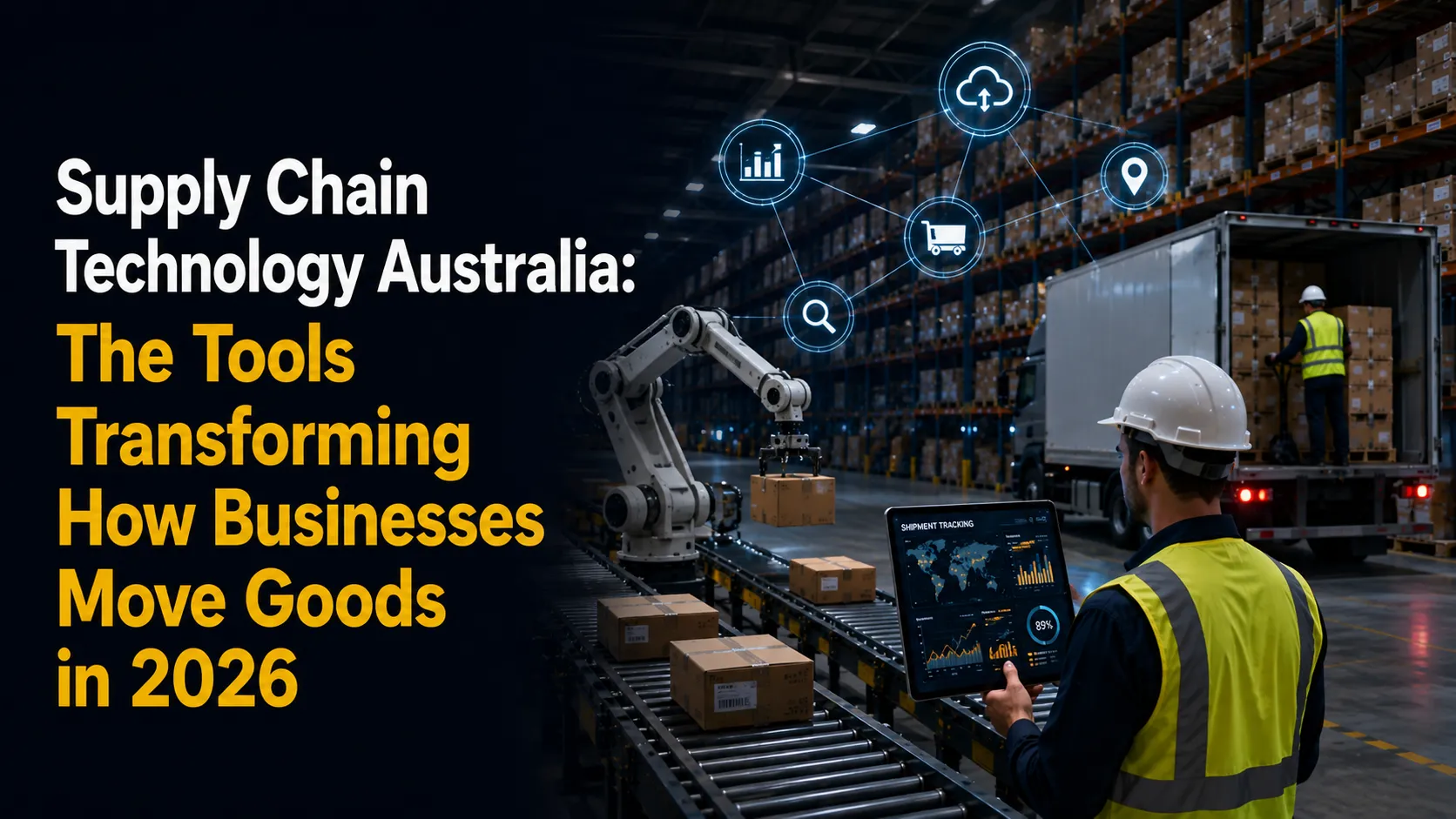
Most businesses are unaware how technology is driving the speed of Supply chain technology in Australia. And the gap between early adopters and everyone else is growing every quarter.
Maintaining a competitive edge in the supply chain, both in terms of technology and in the overall industry, has become a must for Australian businesses, according to DHL’s 2026 Logistics Industry Trends report. The change is not a step by step process. It’s structural. The investments a business makes in the right technology are creating an advantage that will be difficult to catch up on later.
This guide explains what supply chain technology entails and the impact it has on Australian businesses. What tools are working in 2026. How to assess and apply them. What to do when the existing tech stack isn’t working.
What Is Supply Chain Technology?
Supply chain technology is the software platform, technology, systems, automation and analytics utilized for the planning, execution, monitoring and optimization of the transportation of products throughout the supply chain.
It includes a variety of tools. Demand planning software. Warehouse management systems. Transport management systems. Visibility platforms. Customs automation. AI-powered analytics.
Each tool addresses a certain issue. They ultimately provide businesses with real-time visibility, improved decision-making, reduced expenses, and elevated service levels. The idea is using the appropriate tools to solve the appropriate problems—and putting them together correctly.
Why Supply Chain Technology Matters for Australian Businesses in 2026
The pressure is mounting on supply chains, the technology is becoming more widely available and the competition is growing rapidly, so supply chain technology is more important to Australian business in 2026 than ever before.
There are a number of factors that are driving the need to adopt technology.
E-Commerce Growth and Customer Expectations
According to the DHL’s Logistics Industry Trends report, the penetration rate of e-commerce households in Australia is over 82% in 2026. That’s a record high. Fast and accurate, tracked delivery is expected. To meet those expectations at scale – the scale of a country as large as Australia – technology is necessary. Manual methods will not be able to catch up.
Labour Shortages
There is a shortage of warehouse people, logistics coordinators and freight managers throughout Australia. Technologies don’t replace people. However, it enables the same team to handle much more volume accurately as well. Companies that automate repetitive tasks have freed up people to engage in human judgment-driven work.
Mandatory Emissions Reporting
FedEx’s March 2026 Australia Logistics Trends report reveals that mandatory emissions reporting is now driving a change in supply chain planning strategies among both Australian exporters and importers.Mandatory emissions reporting is influencing the way both Australian exporters and importers are planning their supply chain, according to FedEx’s March 2026 Australia Logistics Trends report. Freight and logistics emissions are part of Scope 3 and should be measured, managed and reported. Supply chain emission tracking and technology tools that produce reporting fit for compliance are increasingly becoming a necessity.
Supply Chain Complexity
Australian companies are transitioning from a reactive tracking approach to predictive supply chain management with the support of AI and near real-time location intelligence, FedEx says. Australian businesses are served by multiple country, carrier, mode and regulatory supply chains. Without technology, that complexity results in mistakes, delays, and expenses that competitors that can handle it don’t have.
Key Supply Chain Technologies Being Used in Australia in 2026
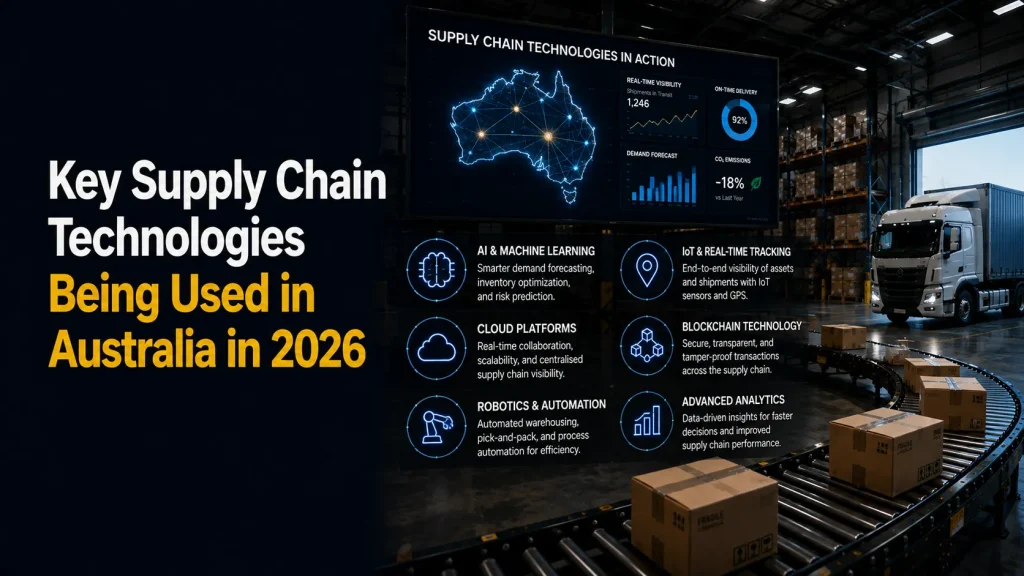
The top supply chain technologies with the greatest return for Australian businesses in 2026 are demand planning software, warehouse management systems, transport management systems, visibility platforms, customs automation and AI-driven analytics.
The following is a description of what each does in actual operation.
Demand Planning and Inventory Optimisation Software
Demand planning software predicts the amount, number and timing of inventory products required. It alleviates the need for spreadsheets that require manual forecasting for business decisions, and instead provides accurate and up-to-date predictions using the statistical method.
The importance of accurate demand forecasting for Australian businesses cannot be overstated. Lead time from Asia is long, as a rule 6 to 10 weeks by sea. Getting the forecast wrong is costly. Excess stockages tie up working capital. Too little means stockouts which lose sales.
AI-based demand planning solutions adapt to patterns in the data. Over time they get better at their accuracy. They deal with complexity – multiple SKUs, multiple channels, seasonality, etc. – much better than manual approaches.
Companies that adopt good demand planning software usually cut up to 20% to 35% in forecast inaccuracies. Which then leads to lower safety stock, less stock out and improved cash flow.
Warehouse Management Systems (WMS)
A WMS manages and optimises all things in the warehouse. Receiving. Putaway. Picking. Packing. Despatch. Guides staff to the correct areas and correct order. It reduces the time and maximises throughput.
Today’s WMS systems offer more. They dynamically optimise product slotting using velocity information. They are compatible with robots and automation. They create live inventory reports. They are compatible with carrier systems to enable automatic generation and tracking of labels.
Warehouse automation is powered by a modern WMS. Robots that are not well directed by the WMS will not do their job.
Transport Management Systems (TMS)
A TMS is used for handling freight booking, freight rate comparison, carrier selection, shipment tracking, and freight invoice reconciliation. It can automate hours of manual work that freight managers have to do weekly.
If your business has a high freight spend, then a TMS is definitely a value proposition for your business in Australia. It can make real-time comparisons of carrier rates. It monitors all the shipments on a single dashboard. It automatically matches freight invoices with booked rates — finding overcharges that manual reconciliation cannot.
Also, a TMS produces freight spend analytics. Displays total costs by carrier, lane and mode. This helps businesses negotiate better at contract renewal terms.
Supply Chain Visibility Platforms
The visibility platforms offer instant visibility along the entire supply chain. Since the time a shipment is shipped from the supplier to the time it arrives at its destination.
Traditional tracking will tell you where a shipment is. AI-driven visibility platforms provide you with the insight to anticipate problems before they occur. They observe port congestion, carrier performance, geopolitical risk, and weather events. They notify businesses if a shipment is going to be delayed — before the delay takes place.
Predictive visibility empowers Australian businesses with their long international supply chains to take proactive measures. Adjusting inventory orders. Early communication with customers. Port diversion. The earlier these interventions are implemented, the less expensive they will be.
Customs Automation Tools
There is considerable paperwork involved in customs clearance. Commercial invoices. Packing lists. Certificates of origin. Import declarations. These documents can be automatically converted to machine-readable format using optical character recognition (OCR) technology. It ensures data is not entered manually and eliminates the possibility of manual data entry errors.
Products are automatically classified with HS codes using AI tools. This helps to minimise classification error, which is one of the key reasons for customs delays in Australia.
In addition, customs automation systems are starting to detect FTA concession opportunities. They determine if imported products should be subject to a lower rate of duty under Australia’s free trade agreements. For regular importers, the duty relief that can be achieved by claims for concessions can be significant.
AI-Powered Analytics
In every part of the supply chain, AI-driven analytics convert data into insights and actions. They discover patterns that human analysts wouldn’t notice. They identify exceptions quickly. A supplier that has increasingly long lead times. A carrier that has problems being on time. A product category is a category that is seeing demand that differs from the forecasts.
Supply chain analytics platforms gather information from the technology supply chain. WMS. TMS. Demand planning. Visibility platforms. This provides comprehensive operational visibility, not just limited to the views of different systems in the supply chain.
How to Build a Supply Chain Technology Stack in Australia
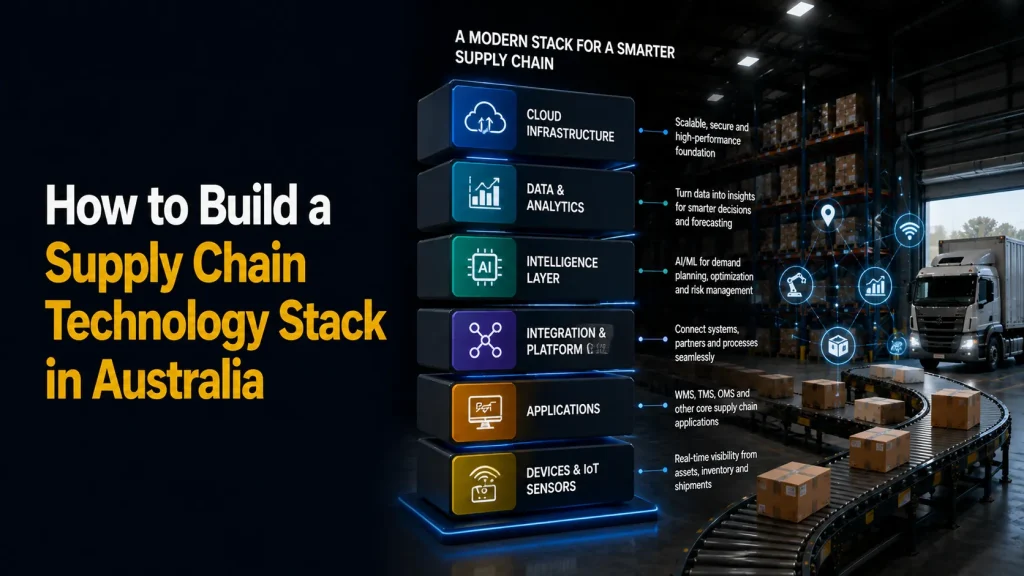
Creating a stack of supply chain technologies is a process that begins with the largest opportunity cost, then includes integration (whether the technology requires it or not), cuts the technology to the bone, and gradually rolls it out.
There are two common errors that most businesses make. They do nothing — using spreadsheets and manual methods until they’re in pain. Or they attempt to do too much, too soon. Neither works well.
Start With the Biggest Pain Point
The key is to begin at the function that is causing the most delay, error or cost. That’s demand planning for some businesses. It’s warehouse management for others. For others, it’s freight visibility.
Tackle the most costly problem first. Look for the right technology to solve it. This provides quicker return on investment. It also sets the groundwork for additional investment.
Prioritise Integration
Technology in the supply chain only offers what it can when it’s seamlessly integrated. Forecast errors occur when a WMS is not connected to the demand planning system and does not pass real-time inventory data to it. Without the visibility platform integration, a TMS cannot provide tracking gaps.
Functional capability is important, but integration capability is even more important when assessing technology options. Specifically ask how each platform fits in with existing systems. Test those integrations prior to committing.
integrations before committing.
Avoid Over-Engineering
Not all technology is the most sophisticated technology. A company with 100 orders per day is not going to require such a WMS as a company with 10,000. Ensure that the technology is appropriate for the size and scope of the work. It is not necessary to over-engineer when it creates unnecessary cost, implementation complexity, and user adoption issues.
Implement in Phases
A single-step full transformation to the technology of the supply chain is a high-risk approach. That risk is lessened when it is implemented in stages. Look at the most valuable (low-risk) technology first. Add capability progressively. Make sure that each phase brings value before the next one starts.
A common approach is to begin with a modern WMS. Once the WMS is integrated, adds demand planning. Then adds a TMS as the number of freight volumes comes to a level that makes investment worthwhile. Then adds visibility and analytics as data from the other systems evolves.
Supply Chain Technology and the Role of Consulting
Technology choices in the supply chain are not solely about technology. They’re business choices that have longer implications.
If you choose the wrong WMS, and then put it into place incorrectly, you will have issues that take years to resolve. Other demand planning methods, based on inadequate information, produce forecasts that fall short of what intuition would suggest. The incorrect TMS and the incorrect carriers fails to realize the cost savings that it was supposed to achieve.
It’s not just about assessing software capabilities to get supply chain technology right. It involves an awareness of the context in which the operation is to take place. The flow of goods in reality. Where the actual restraints are. What the capability and change management tolerance of the team is.
That is where supply chain consulting can come in handy. A consultant who has been able to deploy WMS systems in Australian warehouses and has sifted through a range of TMS solutions for a variety of freight scenarios, and has experience in customs automation, is best placed to assist businesses with technology decisions that yield results.
FR8WISE combines this expertise in its technology consulting for the supply chain sector. We assist enterprises in determining their technology investments’ ROI. We consider choices in a logical and orderly way. We conduct implementations that are on time and on budget. And we evaluate against the business case.
Think Global Logistics (TGL) provides specialist advice throughout the international supply chain and technology landscape, for businesses that wish to gain further strategic advice on international trade and global supply chain design.
How FR8WISE Supports Supply Chain Technology in Australia
The FR8WISE supply chain team is involved in assessing, introducing and improving supply chain technology within the wider context of supply chain improvement for Australian businesses.
Our supply chain technology consulting services cover:
Technology needs assessment. Determining the highest cost and error points in manual processes. Identifying what investments in technology would yield the greatest benefit.
Assessment and installation of WMS. Supporting businesses in the right warehouse management system selection. Managing the implementation. Evaluating against standards.
Demand planning implementation. Improving the ability of the buildings sector to forecast demand. Choosing the appropriate platform. Establishing data feeds. Training teams. Incorporating the process into the business.
TMS Selection and optimization. Assessing transport management systems. Enhancing carrier connectivity and carrier rate management.
Visibility platform assessment. Finding the appropriate supply chain visibility solution. Implementing it with older systems.
Customs automation. Adopting the tools that will decrease document processing time, increase classification accuracy and uncover FTA concession opportunities.
From the beginning of your supply chain technology path, through to replacing sub-optimal systems, to connecting silo-based platforms — FR8WISE can help.
Common Supply Chain Technology Mistakes Australian Businesses Make
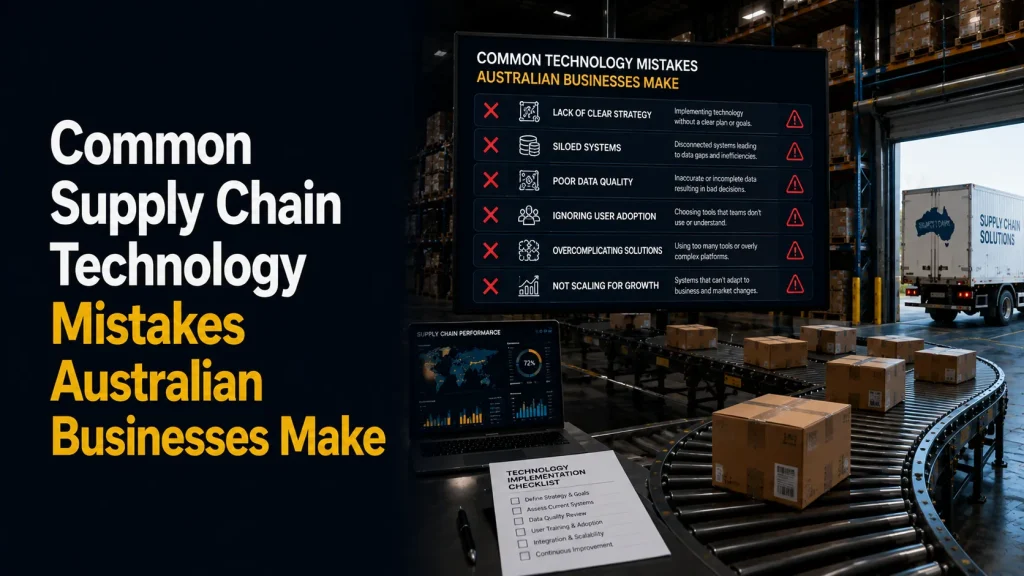
Wringing technology out of the supply chain is costly. These errors are constantly made. Most are avoidable.
Buying technology before defining the problem. A lot of businesses decide on a WMS and/or TMS after demo. Then they find that the software is not suitable for their operation. State the problem first. Then discover the technology that can solve it.
Underestimating data quality.AI-powered tools are only as good as the data they run on. Bad inventory data results in poor demand forecasts. Poorly maintained shipment records result in inaccurate freight analysis. Data cannot be cleaned and structured in a way that is not required prior to implementation. It’s the foundation.
Ignoring change management. People kill more technology implementations than software. Planners who are not confident in the forecast output. Warehouse employees who function around the WMS, but not through it. Freight managers still using spreadsheets due to unfamiliarity with the TMS. Whether or not a technology investment pays off depends on how well you handle the change, which includes training, communication, leadership buy-in.
Not measuring the baseline. Measure current performance in the supply chain before you start using any supply chain technology. Forecast error rate. Order accuracy. Freight Cost per Order. Pick speed. There’s no way to tell if the technology is effective without a baseline. But with the demonstration, it is difficult to justify any more investment.
Over-relying on a single platform vendor. Some vendors offer an “all in one” supply chain platform. It seems like a great idea, everything in one location. In real life, all-in-one platforms provide a compromise in functionality and performance for any single function of a specialist tool. The top supply chain technology stacks usually aren’t defined by a single vendor offering all the tools. Rather, they’re composed of best-of-breed tools that are connected together with well-thought-out integrations.
Treating technology as a one-off project. The technology of supply chain is not an automatic investment. Markets change. Business models evolve. Technology improves. What worked well with the WMS three years ago may not be the best choice for the present. Technology reviews, which are conducted at least once a year, maintain the stack up to date and competitive.
Frequently Asked Questions: Supply Chain Technology Australia
What is supply chain technology?
The technology of supply chain is not an automatic investment. Markets change. Business models evolve. Technology improves. What worked well with the WMS three years ago may not be the best choice for the present. Technology reviews, which are conducted at least once a year, maintain the stack up to date and competitive.
What supply chain technologies are most important for Australian businesses in 2026?
Demand planning software, warehouse management systems, transport management systems, supply chain visibility platforms, customs automation tools, and AI-powered analytics are the most valuable technologies. The right priority is dependent on the areas of the biggest gaps in the current operation.
How do I know which supply chain technology my business needs?
First, determine the areas where there are the most high costs, errors, or delays in the manual processes. That difference represents the technology that would offer the best return. An experienced consultant can carry out a supply chain technology assessment that gives a structured prioritisation of investments.
How much does supply chain technology cost in Australia?
Costs vary widely. For smaller companies, the cost of cloud-based demand planning platforms begin at a few hundred dollars each month. The cost for WMS platforms to be implemented is from $20,000 to several hundred thousand dollars. The price of TMS is typically determined by the number of shipments and is usually paid on a subscription basis. There are different visibility platforms depending on the trade volume and integration needs.
Does supply chain technology require a large IT team to implement?
Not necessarily. A lot of modern platforms are cloud-based Saas products that can be implemented without a massive in-house IT infrastructure. But project management, data preparation and change management are other areas that do require external consulting support, and in which it adds significantly to successful implementation.
How long does it take to implement supply chain technology?
This is dependent on the technology and business. It takes as little as four to eight weeks to deploy a cloud-based demand planning solution. The implementation of a WMS usually takes 3 – 6 months. It could take from four to eight months to integrate the TMS with complex carrier integrations. The implementation is phased, which allows for a faster TTFR.
How does supply chain technology connect to sustainability?
Route optimisation helps to save fuel and emissions. Demand planning helps minimise the excess inventory and warehousing energy. Data created by visibility platforms that can be used for Scope 3 emissions reporting. Mode optimisation tools enable decision making on changing from air to sea freight, which is the biggest emissions reduction opportunity for most Australian importers.
FR8WISE — Strategic Supply Chain & Logistics Solutions | Sydney, Australia