


Written by the FR8WISE Supply Chain Team | FR8WISE is a Sydney-based logistics and supply chain consultancy working with Australian businesses across 14 industries to improve procurement, freight, warehousing, and end-to-end supply chain performance.
For most businesses in Australia, Supply Chain Management is a topic that doesn’t come up until it goes wrong.
A supplier is late with delivery. Freight rate suddenly increases. A product is received with defects. During the most popular week of the year, stock runs out.Stock is sold out during the most popular week of the year.
The invisible chain of supply ends at this stage. It quickly turns into the hottest business issue.
This guide provides an overview of what supply chain management is in Australia. How it is implemented in various sectors. What the greatest problem is at the moment. And how to create a thing that cannot be broken.
What Is Supply Chain Management?
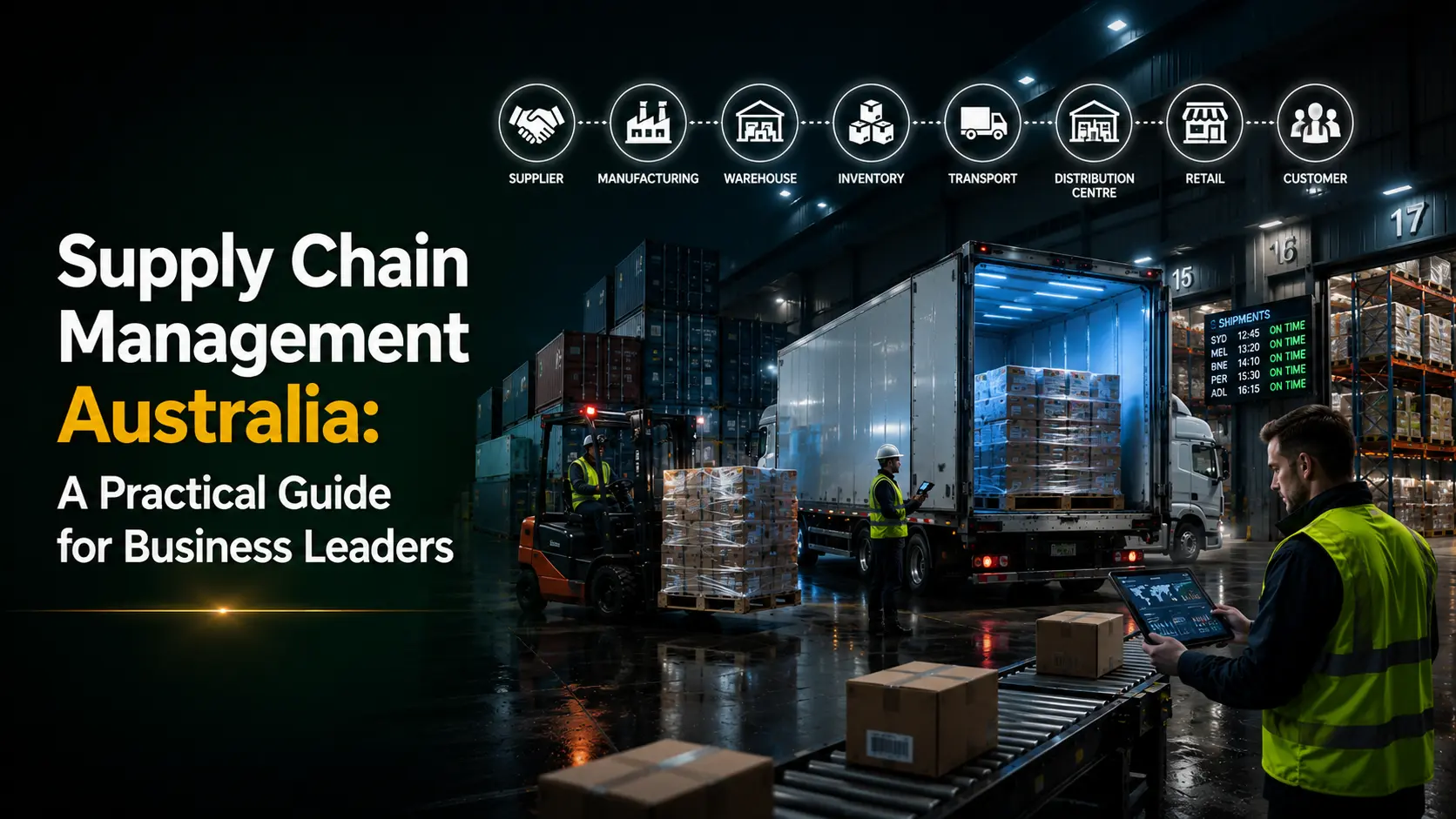
Supply Chain Management Australia is a process that involves planning, coordination and control of all activities related to sourcing, manufacturing and delivering a product from the raw material to the end customer.
It includes all the links in the chain. Supplier relationships and procurement. Manufacturing and production planning. Warehousing, inventory management. Freight and logistics. Customs and compliance. Last mile delivery. Returns.
With its proper implementation, the good use of Supply Chain Management Australia will help to lower cost, enhance reliability, and provide a solid competitive edge to businesses. If it’s not done well, it can be a reactive firefighting nightmare and a very costly and stressful experience, which you can see, hear and feel by the customer.
Supply chain management in Australia has some unique challenges due to its geography, trade relations and regulatory framework. Recognising context as the foundation of creating something that will work.
Why Supply Chain Management Is Different in Australia
The geography, the high cost of logistics, the strong focus on international trade, and the complexity of compliance at each stage of the supply chain constitute the key characteristics of Australian supply chain management.
The Distance Problem
Australia is the world’s sixth largest country (by land mass). We have only a few coastal cities with a population of 26 million. Large distances and freight costs are the problem between the three cities Sydney to Perth, Brisbane to Melbourne, Adelaide to Darwin.
The distances are even more amazing for international trade. Australia is located a long way from its key trading partners. It normally takes 12–22 days to ship from China to Sydney. From the west coast of the USA, it takes 18-25 days. These transit times need to be incorporated into inventory planning. Businesses that don’t consider lead times, find themselves with no inventory when they most need it.
The Cost Problem
Australia is an expensive country to ship to. They are driven up by fuel prices, drivers’ pay, port charges, and lack of infrastructure. Freight is one of the three major lines of business expense for many companies. Well managed, this can be a direct contributor to margin.
The Trade Dependency Problem
Australia is very reliant on international trade. We are importing lots of manufactured goods, electronic products, clothing and industrial equipment. Agricultural goods, minerals and energy are exported. Complex international logistics, customs compliance and supplier relationships with multiple countries and time-zones both involve.
The Disruption Problem
Many Australian supply chains were found to be fragile in the last few years. A global pandemic. Major port congestion. Geopolitical tensions. Disruptions to shipping through the Red Sea. Companies relying on one supplier, one trade lane, or just in time inventory with no buffer they learned their lesson the hard way!
Resilience is no longer an option for Australian businesses, it is a requirement for supply chain management. This is an essential necessity.
The Core Functions of Supply Chain Management
The 6 modules of supply chain management are: Procurement, Production Planning, Inventory Management, Warehousing, Logistics and Freight, and Returns Management.
Procurement and Supplier Management
Identifying, screening and overseeing suppliers to get the raw materials your company requires. This means negotiating contracts, managing suppliers, tracking risks and deciding whether to single source or multi source.
Purchasing choices today can have vulnerabilities or strengths that are felt over months and years. An increase in the unit cost due to any disruption event could wipe out the 5% cost saving achieved by single sourcing.
Production and Demand Planning
Matching the supply and demand. Predicting customers’ buying behaviour, timing, and amounts. Then ensuring that the supply chain can deliver on it. The costs of wrong demand planning are high if it is either over or under. Too much inventory is a deadweight investment of money. Too little is lost sales and dissatisfied customers.
Inventory Management
Regulating the inventory between suppliers and customers. The amount to be held, the way to hold it, and the method of maintaining it. Inventory is cash. Each dollar in stock is a dollar that cannot be used elsewhere. Good management is to keep enough to satisfy demand but not more than necessary.
Warehousing and Storage
The infrastructure that exists between the supply and demand. The location, organization, picking and packing efficiency of goods. A well-run warehouse minimizes costs and increases the service level. One that doesn’t become a drag on the whole supply chain.
Logistics and Freight
Transporting materials from one location to another both within the country and between countries. Road, rail, sea, air. The various modes are at different costs, speeds and reliability. Logistics management is the ability to send the right product in the right mode at the right time and the right price, as well as monitoring and controlling carriers.
Returns Management
Customer-refunded goods. In certain categories online return rates are as high as 20-30 per cent. The return of the product through the supply chain, evaluation, re-stocking, or disposal of the product that’s reverse logistics. A huge operation challenge. It is an area of under-investment for most businesses.
Supply Chain Management Challenges in Australia Right Now
Australian businesses face four key challenges in the supply chain – cost pressure, supply chain visibility, labour shortages and geopolitical risk and the transition to sustainable operations in 2026.
Cost Pressure
Fares remain high due to the early 2020s disruption. The energy cost, labour cost and port charges have all gone up. The cost position of the supply chain is structurally more expensive than before 5 years ago. It’s not just hoping that rates will come down, it takes systematic analysis and renegotiation.
Supply Chain Visibility
A significant number of businesses in Australia do not have real-time knowledge of goods locations. Especially on transoceanic flights. Two weeks ago a container left Shanghai is it at Port Botany? Boarded ship in Singapore? Held up at customs? Without sight, a business can’t make right decisions. Nothing on the inventory, nothing on the customer orders, nothing on the production planning.
Labour Shortages
There is a shortage of warehouse workers, transport drivers and logistics coordinators. There is a particular shortage of skilled logisticians, heavy vehicle drivers and refrigerated transport staff. Companies are reacting to that with automation, greater wages and improved working conditions. This is a medium-term limitation, though. It will not go away rapidly.
Geopolitical Risk
Australia’s supply chains are vulnerable to geopolitical events. Agricultural trade was held up by conflicts with China. The Red Sea crisis is causing a time and cost delay in European shipping routes. The U.S. tariff changes are driving sourcing changes in a variety of industries.
This is a problem for diversification (supplier, trade lanes, sourcing countries). And scenario planning. If your primary supplier country cuts back on exports, what do you do? What’s your backup?
Sustainability and Emissions Reporting
Australian businesses with revenues over $500 million are now required to make mandatory climate related disclosures. This includes scope 3 emissions (supplier and logistics providers). Now supply chain decisions are taking a carbon dimension.Now carbon is a dimension of supply chain decisions. All aspects of carrier selection, mode choice, supplier location etc. have an impact on your reported emissions profile.
How to Build a Resilient Supply Chain in Australia
Supplier diversification, inventory buffers, real-time visibility, a solid carrier relationship and a regular cycle of risk assessment and scenario planning are key pillars of a resilient Australian supply chain.
Diversify Your Supplier Base
Single-sourcing may seem to work fine on a spreadsheet. It’s a weakness in practice. Multi-sourcing (qualifying two or more suppliers as key inputs) is more costly to manage, but can dramatically limit risk of one supplier failing to perform and cause the disruption of your entire operation.
Build Inventory Buffers for Critical Items
Just in Time inventory is applicable to stable regular and predictable supply chains. Australia’s supply chains are not.Australia’s supply chains are not. Use safety stock for critical items (where you can’t operate or serve customers without stockout). It’s almost always cheaper to keep than it is to cause disruption.
Invest in Visibility
What you don’t know you don’t have to manage. Buy into supply chain visibility: a platform, more carrier integration or better reporting from your 3PL. It provides you with the data you need to make informed decisions and quickly adapt to changing circumstances.
Map Your Supply Chain Risk
The majority of companies are familiar with their tier-one suppliers. Less are aware of their tier-two, tier-three the businesses that provide Tier two. It’s a disruption at tier two that’s just as strong. However, without the right risk map you won’t be able to see it coming.
Find key nodes. Know the consequence of each one failing. Plan with intent in terms of resilience investments.
Negotiate Long-Term Carrier Relationships
When capacity is available, spot market freight is acceptable. It’s a calamity when things are tight. In circumstances of limited space, businesses who are extended carriers are given precedence. They also receive preferential rates in the medium term.
Review Your Supply Chain Regularly
Your business’s supply chain may not be the best chain for your business today. In the world of trade lanes, locations, product mixes, supplier performance, all of these shifts. If a regular review of the supply chain is in place, at least once a year, it will identify drift before it becomes problematic.
Technology in Australian Supply Chain Management
AI-powered analytics, transport management systems, warehouse management systems, demand planning software and supply chain visibility platforms are the key technologies used in the supply chain across Australian businesses.
Supply Chain Visibility Platforms
These provide a single view of good location throughout the supply chain, from supplier to customer. Real-Time tracking, exception management and milestone alerts. In businesses that have complex international supply chains, visibility may be the most valuable technology investment for Australian companies.
Demand Planning Software
Forecasting methods based on statistics that look at past data, seasonal trends and market signals to help forecast demand. In turn, this equates to more accurate inventory decisions with better forecasts. Less stockout risk. More cash freed up from overstocking.
Warehouse Management Systems (WMS)
Warehouse Management Software: It is the software that regulates and optimises warehouse activities. Directed picking, inventory tracking, management of labour, integration with order management and carrier systems. It’s the foundation of an efficient warehouse.It’s the technology backbone of an efficient warehouse.
Transport Management Systems (TMS)
Freight Management Software is the application used to handle bookings, choosing carriers, comparing rates, tracking, and reconciling invoices. A TMS reduces manual workload, enhances rate compliance and provides visibility on freight spend per carrier, per lane and per mode.
AI and Predictive Analytics
AI is becoming a more common tool for supply chain management in Australia. Demand forecasting, route optimisation, supplier risk monitoring, anomaly detection. These tools help businesses make better decisions quicker. They prevent issues from becoming emergencies.
Australian businesses have achieved a 25% to 35% error reduction in their forecasts when they have adopted demand planning software. Which translates to reduced safety stocks, fewer out-of-stocks and improved cash flow.
Supply Chain Management Across Key Australian Industries
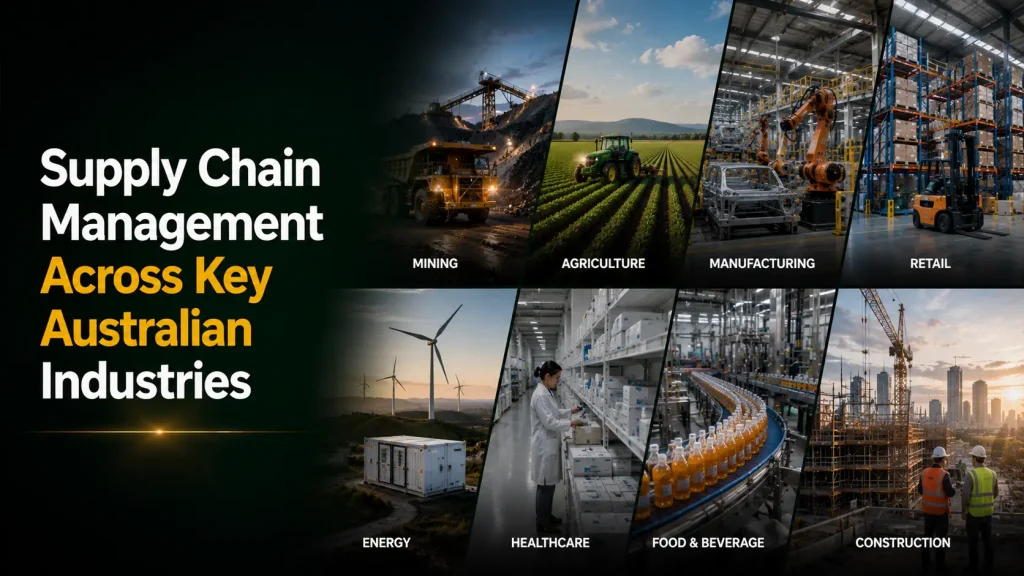
Each industry has its own unique approach to supply chain management. Let’s see what happens in some of the main industries that make up Australia.
Food and Agriculture
Australia is an important exporter of food. For perishables such as fresh produce, meat, dairy, and seafood, the logistics of managing the supply chain also depends on cold chain logistics, compliance with biosecurity regulations, and the coordination between farm and processor logistics and export logistics.
There are various issues in the domestic food supply chains. The shape of the order curve, its seasonal variation, short shelf life and the price sensitivity of the retail sector towards the lack of compliance of the orders..
Retail and E-commerce
Australian retail supply chains are now online shopping transformed. A certain percentage of total retail sales are now ecommerce. Rapid fulfillment, flexible delivery and simple returns are just some of the elements that are fundamentally different from the supply chain needs of bricks-and-mortar retail.
One of the most pressing issues for retailers in Australia today is the need to manage the supply chain effectively, all while supporting both sales channels.
Construction and Resources
The transport of material and equipment in Australia’s resources and construction industries is vast. Specialist logistics are required for supply chains for mining, oil and gas, and large scale infrastructure. Large, bulky goods, delivery from distance, just in time for active construction sites.
Every delay equals an additional expense on the project. It’s a matter of life and death. That’s reflected in supply chain management in this industry.
Healthcare and Pharmaceuticals
Australia’s pharmaceutical supply chains are one of the most regulated supply chains worldwide. Everything from TGA compliance to cold chain requirements for biologics and vaccines, and serialisation for track and trace, makes pharmaceutical supply chain management a specialist field.
Regulatory compliance makes compliance for businesses importing a pharmaceutical product or medical devices a more complex task than it sounds.
Frequently Asked Questions
What is supply chain management?
Supply chain management (SCM) refers to the process of managing the entire supply chain to ensure a product reaches its end-user in the best possible condition.Supply chain management (SCM): This is the management of all activities that are required to get a product from the raw material to the end user, including procurement, production, inventory, warehousing and logistics, and returns.
Why is supply chain management important in Australia?
Supply chain management is more difficult in Australia than in most similar markets, due to issues associated with geography, reliance on trade, logistics costs and the regulatory environment. Managing a supply chain is a real competitive advantage. An unmanaged and mismanaged one can cause ongoing cost and disruptions.
What are the biggest supply chain challenges in Australia right now?
The key issues for 2026 include freight rate risk, lack of supply chain visibility, labour scarcity in the supply chain, geopolitical trade route risk, and increased demand for supply chain emissions management and reporting.
How do I improve my supply chain in Australia?
Start with an audit. Know Areas of current gaps/costs. Then take a look at the biggest gains: supplier diversification, inventory optimisation, visibility investment, and carrier relationship management.
What is supply chain resilience?
It’s the ability to absorb disruption and quickly bounce back. It is derived from a multiple sourcing approach, stocking safety reserves of key products, and developing good relationships with carriers, the deployment of real-time visibility, and frequent risk analyses.
How does supply chain management connect to freight forwarding?
Freight forwarding deals with international shipping, customs clearance and transport. It’s one component of the broader supply chain. Even if freight forwarders are good, poor procurement or inventory management will translate to supply chain issues. The pieces should function in unison.
When should a business bring in a supply chain consultant?
If the cost of the supply chain is increasing at a rate that exceeds profits. If the disruptions happen often. In the case of a business preparing to enter an unfamiliar market and/or expand size substantially. In the event that the existing supply chain failed to track pace of growth. All these are indications that a proper review would be of benefit.
How FR8WISE Supports Supply Chain Management in Australia
The FR8WISE supply chain team collaborates with Australian businesses in 14 sectors, helping to establish supply chains that are efficient, resilient and ready to grow.
This is not just a logistics review, it is a scope review. FR8WISE encompasses the entire supply chain, from procurement strategy, supplier management, freight forwarding, customs compliance, to warehousing and delivery. Issues in one place will almost always be traced back to another place. Individual items cannot be viewed in isolation of each other. Solutions that don’t tackle root causes are not enduring.
Along with FR8WISE’s hands-on experience in Australian and international supply chains. We’ve experimented with what works and doesn’t at food, in retail, in construction, in healthcare, and so on. All of our recommendations are based on that experience.
Think Global Logistics (TGL) provides specialized expertise throughout the global supply chain landscape for businesses seeking strategic supply chain consulting, not limited to logistics, but also in procurement strategy, market intelligence and international trade planning.
From a specific supply chain challenge to growth planning, to building resilience or re-starting in a new market, there are many ways FR8WISE can help.