


Written by the FR8WISE Supply Chain Team | FR8WISE is a Sydney-based logistics and supply chain consultancy working with Australian businesses across 14 industries to improve freight, fulfilment, and cold chain operations.
One degree too warm. That’s all it takes.
A pallet of fresh seafood. A shipment of vaccines. A batch of ready meals heading to a supermarket distribution centre. If the temperature breaks at any point in the journey — loading, transit, unloading — the product is compromised. Sometimes it’s unsellable. Sometimes it’s a regulatory breach. Always, it’s a cost.
Refrigerated transport Australia is one of the most complex and high-stakes parts of the supply chain. This guide covers how it works, what’s involved, what it costs, and how to manage it properly.
What Is Refrigerated Transport?
Refrigerated transport is the movement of temperature-sensitive goods in vehicles or containers that maintain a controlled temperature environment throughout the journey from pickup to delivery.
It’s not just about keeping things cold. Different products need different temperature ranges. Maintaining those ranges precisely across loading, transit, and unloading is what separates a functioning cold chain from one that fails.
Chilled goods like fresh produce and dairy typically require 0°C to 5°C. Frozen products like meat and ice cream need -18°C or below. Pharmaceuticals and vaccines often require tighter ranges — 2°C to 8°C for most biologics, and as low as -80°C for certain mRNA products. Getting any of these wrong has consequences. Spoilage. Regulatory breaches. Product recalls. Patient safety risks.
Why Refrigerated Transport Matters in Australia
Australia’s geography, climate, export volumes, and strict food safety regulations make refrigerated transport both more critical and more complex here than in most comparable markets.
We export billions of dollars of perishable goods every year beef, lamb, seafood, dairy, fresh produce. Most of it goes to Asia. Japan, China, South Korea, Singapore they all demand product that arrives in perfect condition. The correct temperature must be maintained from farm or factory to port. No exceptions.
Domestically, the distances are enormous. Moving refrigerated freight from a meatworks in regional Queensland to a supermarket in Melbourne is a multi-day journey. The cold chain has to hold the entire trip. Through loading, long-haul road transit, possible rail legs, and final delivery.
Then there’s the climate. Australian summers push ambient temperatures above 40°C in many regions. That puts enormous strain on refrigeration equipment. A truck that runs fine in a Sydney winter can struggle in outback Queensland in January. Equipment reliability is not optional here.
We’ve worked with food exporters and pharmaceutical distributors who underestimated cold chain complexity. One shipment failure cost them more than a year’s worth of logistics savings. The lesson is always the same. Refrigerated transport needs active management not just the right vehicle.
Types of Refrigerated Transport in Australia
Refrigerated transport in Australia covers four main modes: refrigerated road transport, refrigerated rail, reefer shipping containers for sea freight, and temperature-controlled air freight.
Refrigerated Road Transport
The most common form of cold chain logistics in Australia. Refrigerated trucks ranging from small vans for last-mile delivery to B-double refrigerated trailers for long-haul freight move temperature-sensitive goods across the country every day.
Road transport offers door-to-door flexibility. No other mode can match it. It’s the only option for final-mile delivery to retail stores, distribution centres, or direct to customers. The trade-off is cost and driver availability. Both have become harder in recent years.
Key considerations for road refrigerated transport:
- Pre-cooling the vehicle before loading a warm truck loaded with cold product is a cold chain breach waiting to happen
- Monitoring temperature throughout transit, not just at pickup and delivery
- Managing delivery schedules to minimise time at ambient temperature during loading and unloading
- Maintaining equipment a refrigeration unit failure mid-journey in remote Australia is a serious operational problem
Refrigerated Rail
Growing in importance, particularly for long-haul routes between the east coast and Perth. Companies like Lindsay Australia and Qube Logistics have expanded their rail cold chain capabilities.
Rail is slower than road. But it’s substantially cheaper for high-volume bulk movements. It also produces significantly lower carbon emissions. That matters more every year as Australian businesses face mandatory Scope 3 emissions reporting.
Rail works best for frozen goods where transit time is less critical. Fresh produce with short shelf lives is harder to move by rail.
Reefer Containers (Sea Freight)
Refrigerated shipping containers reefers — are the backbone of Australia’s cold chain export business. Fresh beef heading to Japan, live seafood going to China, dairy products destined for Southeast Asia all of it moves in reefer containers through Australia’s major ports.
Port of Melbourne, Port of Brisbane, Port Fremantle, and Port of Sydney all handle significant reefer volumes. Managing reefer shipments involves coordinating with the shipping line on container availability. The container must be pre-cooled before stuffing. Temperature must be monitored throughout the ocean voyage.
Biosecurity adds complexity. Average dwell time for containerised perishables at Australian ports climbed to 3.8 days in 2025. Intensified biosecurity protocols required additional fumigation and manual inspections. That’s 3.8 days where temperature control must hold while cargo sits at port.
Temperature-Controlled Air Freight
The fastest option. Essential for high-value, short-shelf-life goods live seafood, certain pharmaceuticals, time-critical fresh produce. Tasmanian lobster to Japan in 24 hours. Vaccines to a remote community in the Northern Territory on the same day they’re ordered.
Air freight is expensive. The refrigeration capability on cargo aircraft is also more limited than dedicated road or sea cold chain options. It’s the right choice when speed justifies the cost not as a default.
Temperature Requirements by Product Category
Different products require different temperature ranges, and understanding these requirements is fundamental to choosing the right refrigerated transport solution.
| Product Category | Temperature Range | Notes |
| Fresh produce | 0°C to 8°C | Varies by product; some fruits sensitive to chilling injury |
| Dairy products | 1°C to 4°C | Strict shelf-life requirements |
| Fresh meat | -1°C to 2°C | Super-chilled for export to extend shelf life |
| Frozen meat/seafood | -18°C or below | Standard frozen requirement |
| Ice cream | -25°C or below | Deep-frozen |
| Vaccines and biologics | 2°C to 8°C | Strict TGA compliance requirements |
| mRNA pharmaceuticals | -80°C to -60°C | Ultra-low, specialist equipment required |
| Chilled ready meals | 0°C to 4°C | Short shelf life, frequent delivery cycles |
Getting the temperature range wrong is not just a product quality issue. For pharmaceuticals, it’s a regulatory breach. For food exports, it can result in rejection at the destination country’s border a costly outcome that damages the exporting business’s reputation with the buyer.
Cold Chain Compliance in Australia
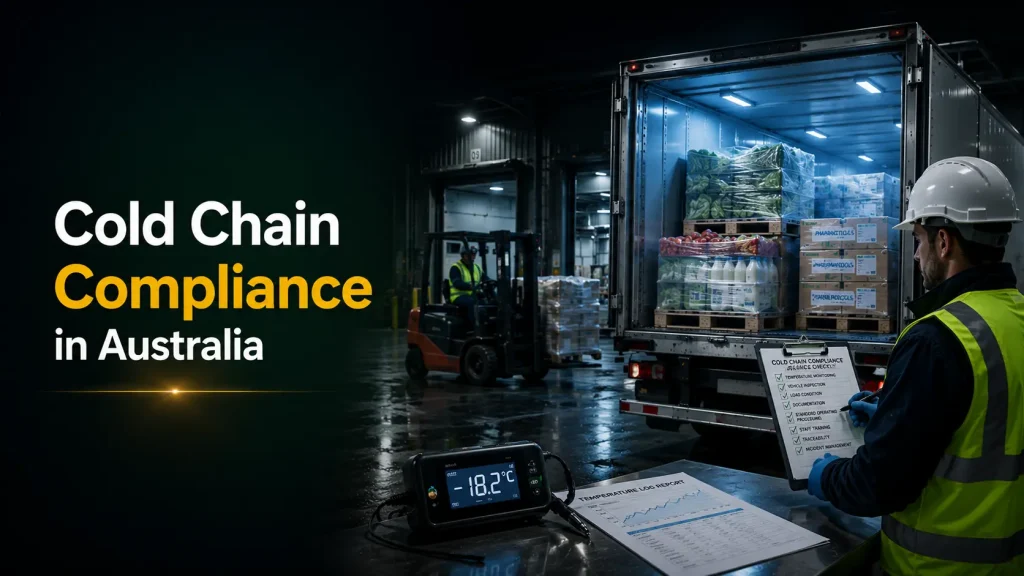
Refrigerated transport in Australia is governed by a combination of food safety legislation, TGA pharmaceutical standards, and biosecurity requirements all of which carry serious consequences for non-compliance.
Food Safety Standards
The Australia New Zealand Food Standards Code sets out requirements for temperature control of potentially hazardous foods. The key rule: food that requires refrigeration must be kept at 5°C or below during transport. For frozen food, that’s -15°C or below (though best practice is -18°C).
State and territory food safety authorities enforce these standards. Penalties for non-compliance range from product seizure to prosecution.
TGA Pharmaceutical Standards
Medicines and biologics transported in Australia must comply with the Therapeutic Goods Administration’s Good Distribution Practice (GDP) guidelines. These cover temperature monitoring, documentation, vehicle qualification, and deviation management. A single temperature excursion — even a brief one — must be documented. It must be assessed for impact on product quality. No shortcuts.
Australian Border Force and Biosecurity
For imports, the Department of Agriculture, Fisheries and Forestry oversees biosecurity for refrigerated goods. Certain products require inspection, treatment, or testing before entering the domestic market. Biosecurity holds extend dwell time at port. That’s why having a freight forwarder with cold chain and customs expertise matters for importers of temperature-sensitive goods.
HACCP and Cold Chain Documentation
Most food manufacturing, distribution, and retail businesses in Australia operate under a HACCP food safety program. Cold chain management — including temperature monitoring during transport — is a critical control point. Temperature records are not optional. They’re a legal requirement and a due diligence defence if a food safety incident occurs.
Cold Chain Technology: How Temperature Is Monitored
Modern refrigerated transport relies on real-time temperature monitoring, telematics, IoT sensors, and digital data loggers to maintain and document cold chain integrity throughout the journey.
Data loggers record temperature at set intervals throughout transit. They’re placed inside the load, not just in the vehicle cabin, so the actual product temperature is what’s captured. This data forms part of the cold chain documentation required for compliance and export certification.
IoT temperature sensors take this further. They transmit temperature data in real time to a monitoring platform. If a temperature excursion occurs during transit, an alert fires immediately. Someone contacts the driver. The team investigates the issue. If necessary, they redirect the load to a controlled environment before the product is compromised.
Telematics platforms combine temperature data with GPS tracking, vehicle performance monitoring, and delivery management. For businesses running refrigerated fleets, this gives visibility into where every vehicle is, what temperature it’s running at, and whether any deviations have occurred.
Automated temperature reporting generates documentation for export certification and pharmaceutical compliance without manual data entry. Less admin burden. Fewer documentation errors.
The technology is accessible to businesses of all sizes now. The barrier is no longer cost. It’s implementation and integration with the rest of the supply chain.
Refrigerated Transport Costs in Australia
Refrigerated transport in Australia costs more than standard freight — typically 20% to 40% more for equivalent road movements — due to higher equipment costs, energy consumption, and the specialist nature of the service.
Here’s what drives refrigerated transport costs in Australia:
Equipment costs. A refrigerated trailer costs two to three times more than a standard tautliner to purchase and maintain. Refrigeration units require specialist servicing. This higher capital cost flows through to freight rates.
Energy. Running a refrigeration unit continuously consumes significant diesel or electricity. Fuel surcharges apply to most refrigerated freight contracts — and fluctuate with diesel prices.
Labour. Refrigerated transport requires trained drivers who understand cold chain protocols. Driver shortages in Australia have pushed wages higher, and the shortage is more acute in the refrigerated segment than in general freight.
Compliance and documentation. Temperature monitoring equipment, calibration, and the documentation required for food safety and pharmaceutical compliance all add cost.
Cold storage at origin and destination. Refrigerated transport doesn’t exist in isolation. The cold chain also requires temperature-controlled loading facilities, cold storage at the destination, and proper handling during loading and unloading. Gaps in the chain at either end undermine the transport itself.
Indicative cost benchmarks from the Australian market:
| Service | Indicative Cost |
| Cold storage (chilled) | $25–$45 per pallet per week |
| Cold storage (frozen, 20-30% premium on chilled) | $30–$60 per pallet per week |
| Handling (in/out) | $4–$8 per pallet movement |
| Refrigerated road transport | Rate varies by lane, volume, and distance; fuel surcharges apply |
These are indicative figures. Actual rates depend on volume, lane, carrier relationships, and market conditions at the time of booking.
Common Refrigerated Transport Mistakes Australian Businesses Make
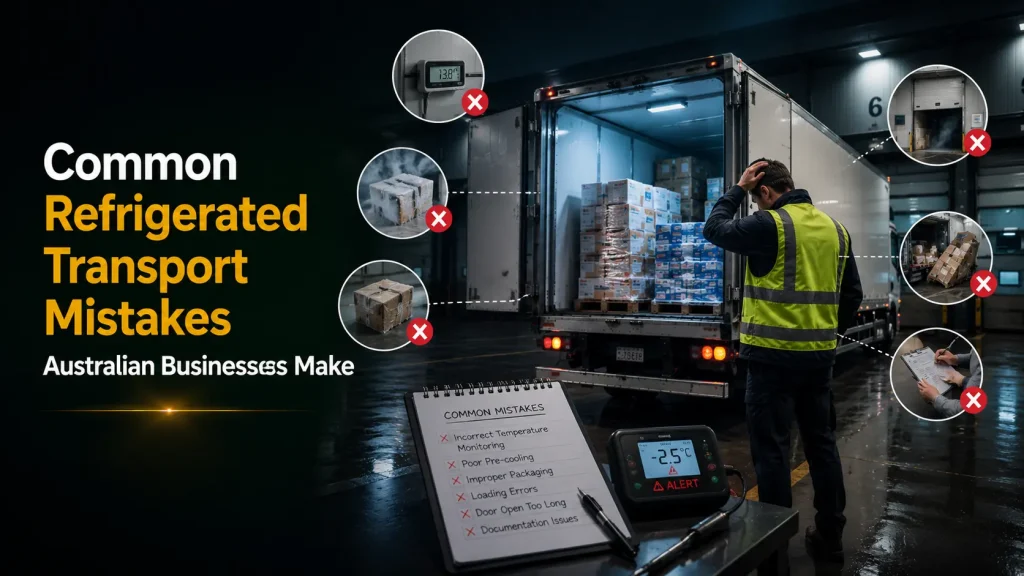
These problems come up repeatedly. Most are avoidable.
Not pre-cooling the vehicle before loading. Loading cold product into a warm truck is one of the most common causes of temperature excursions. The vehicle — and the load space — must be at the correct temperature before loading begins. This is non-negotiable.
Relying on a single temperature reading. A temperature sensor in the vehicle cabin tells you the air temperature near the sensor. It doesn’t tell you the temperature inside a pallet in the middle of the load. Multiple sensors, placed within the load, are needed for accurate monitoring.
Poor loading practices. Blocking airflow inside the refrigerated space, overloading, or mixing products with different temperature requirements all compromise cold chain integrity. Loading is a skill, and it requires training.
No contingency for equipment failure. A refrigeration unit that breaks down on a remote highway in summer is a serious problem. Backup carriers, emergency cold storage contacts, escalation procedures — these need to exist before something goes wrong. Businesses without a plan find out the hard way.
Treating cold chain documentation as an afterthought. For food exports and pharmaceutical shipments, temperature records are part of the product. Incomplete documentation can mean rejection at destination. It can mean loss of export certification. It can mean regulatory action.
Choosing a carrier on price alone. Refrigerated transport is not a commodity. Equipment quality, monitoring capability, driver training, and compliance record all affect cold chain integrity directly. The cheapest option is rarely the lowest-risk one.
How to Choose a Refrigerated Transport Provider in Australia
Choosing a refrigerated transport provider comes down to equipment quality, temperature monitoring capability, compliance track record, carrier network, and experience with your specific product category.
Ask these questions before committing to a provider:
What temperature monitoring do you use? Real-time IoT monitoring is now the standard. Data loggers alone are insufficient for high-value or compliance-critical shipments.
What is your equipment maintenance schedule? Refrigeration units that aren’t regularly serviced fail more often. Ask for maintenance records and breakdown response times.
Do you have experience with my product category? A carrier experienced in pharmaceutical cold chain has different capabilities from one specialising in frozen food. Make sure they understand your product’s specific requirements.
What happens if there’s a temperature excursion? Understand their deviation management process. How quickly are you notified? Who decides whether product is compromised? How is it documented?
What is your coverage and capacity? Can they service your routes, at your volumes, reliably? Do they have capacity during peak periods — summer surges, Christmas, the fresh produce season?
What documentation do you provide? For export and pharmaceutical shipments, you need complete, accurate temperature records. Know exactly what you’ll receive and in what format before you commit.
For businesses importing refrigerated goods from overseas, the cold chain extends to international freight and customs clearance too. That’s where a logistics partner with both cold chain and freight forwarding expertise makes a real difference. For strategic supply chain advice beyond transport, Think Global Logistics (TGL) offers specialist consulting across the full cold chain and international logistics picture.
Frequently Asked Questions
What is refrigerated transport?
Refrigerated transport is the movement of temperature-sensitive goods in temperature-controlled vehicles or containers. It covers chilled, frozen, and deep-frozen products, as well as pharmaceuticals requiring precise temperature management throughout transit.
What temperature is required for refrigerated transport in Australia?
It depends on the product. Fresh food must be kept at 5°C or below under Australian food safety law. Frozen food requires -15°C or below (best practice is -18°C). Pharmaceutical products follow TGA GDP guidelines, which vary by product — 2°C to 8°C for most biologics, and as low as -80°C for certain mRNA products.
How much does refrigerated transport cost in Australia?
Refrigerated transport typically costs 20% to 40% more than equivalent standard freight, due to higher equipment costs, energy consumption, and compliance requirements. Cold storage costs range from around $25 to $60 per pallet per week depending on temperature range and provider.
What regulations apply to refrigerated transport in Australia?
Food transport is governed by the Australia New Zealand Food Standards Code. Pharmaceutical transport must comply with TGA Good Distribution Practice guidelines. Biosecurity requirements apply to imported temperature-sensitive goods. Most food businesses also operate under HACCP programs. Cold chain is a critical control point under all of them.
What is a reefer container?
A reefer container is a refrigerated shipping container used for sea freight. It has a built-in refrigeration unit. It maintains a set temperature throughout the ocean voyage. Reefers are the primary method for exporting Australian perishables meat, seafood, dairy, fresh produce to international markets.
How do I know if my cold chain has been compromised during transport?
Real-time IoT sensors send immediate alerts if a temperature excursion occurs during transit.Data loggers record temperature throughout the journey. Review them on delivery. Document, assess, and report any deviation as part of your cold chain compliance process.
What should I do if there is a temperature excursion during refrigerated transport?
Document it immediately. Assess the duration and magnitude. Contact your carrier and your quality or compliance team. For pharmaceutical products, a formal deviation assessment is required before product can be released. For food products, a risk assessment determines whether it’s still safe for its intended use.
How FR8WISE Supports Refrigerated Transport in Australia
The FR8WISE supply chain team works with Australian businesses across food, pharmaceutical, agriculture, and retail to build cold chain operations that protect product integrity and meet compliance requirements.
Cold chain logistics doesn’t work in isolation. A refrigerated transport problem is often a symptom of something upstream. Procurement decisions that created time pressure. Warehouse processes that delayed loading. Customs clearance delays that extended port dwell time beyond what the cold chain could handle. FR8WISE looks at the whole supply chain picture not just the transport leg.
Whether you’re setting up a cold chain for the first time, dealing with recurring temperature excursions, building an export cold chain for fresh produce or seafood, or managing pharmaceutical distribution compliance FR8WISE has the expertise to help.