


Written by the FR8WISE Supply Chain Team | FR8WISE is a Sydney-based logistics and supply chain consultancy working with Australian businesses across 14 industries to improve freight, fulfilment, and delivery operations.
The last mile is the shortest part of the delivery journey. It’s also the most expensive, the most complex, and the part that customers care about most.
A parcel might travel thousands of kilometres from a factory in China to a warehouse in Melbourne without a single problem. Then it fails to reach a customer ten minutes away — wrong address, missed delivery window, left in the wrong place.
That’s the last mile problem. And in Australia, it’s getting worse.
This guide covers courier services Australia and what last mile delivery actually means why it’s so difficult here, what’s changing in 2026, and what businesses can do to stay ahead.
What Is Last Mile Delivery?
Last mile delivery is the final stage of the shipping process moving a product from a warehouse, distribution centre, or fulfilment hub to the end customer’s address.
It sounds simple. In practice, it’s the most complex and costly part of the supply chain. Last mile costs account for more than 50% of total shipping costs in many operations, according to Capgemini research.
In B2C e-commerce, it matters most. Customers don’t see the warehouse. They don’t see the freight forwarder or customs broker. They see one thing whether the delivery arrived on time, in good condition, and where they expected it. That’s their entire logistics experience.
Get last mile right and customers come back. Get it wrong and they don’t and they leave a review on the way out.
Why Last Mile Delivery Is Harder in Australia Than Most Markets
Australia’s geography, population distribution, high labour costs, and rapidly growing e-commerce market combine to make last mile delivery one of the most complex and expensive in the developed world.
The Distance Problem
Australia is the sixth-largest country in the world by land area. But it has a population of just 26 million people. Most of them live in a handful of coastal cities Sydney, Melbourne, Brisbane, Perth, Adelaide.
That sounds manageable. But outside those cities, delivery gets slow and expensive fast. Regional and remote Australia covers millions of square kilometres. Getting a parcel to a customer in outback Queensland or rural WA is a genuinely difficult logistics problem. And customers in those areas now expect the same delivery experience as someone in inner Sydney.
The Urban Density Problem
Inside the cities, the challenge flips. High-density apartments, limited parking, building access restrictions all of it makes urban delivery harder than it looks.
Failed first-attempt deliveries are a major cost driver. Every redelivery costs money. Every parcel stuck at a collection point creates friction. Customers resent it even when it’s technically “delivered.”
The Cost Problem
Last mile delivery in Australia is expensive. Fuel costs, driver wages, and the time required to navigate urban or regional routes all add up. Carrier rates have risen steadily over the past few years, and for many e-commerce businesses, shipping costs are now one of the biggest line items in their P&L.
As a result, offering free shipping which customers increasingly expect puts real pressure on margins, particularly for lower-value orders.
The Expectation Problem
Australian e-commerce household penetration reached over 82% in 2026, according to DHL’s Logistics Industry Trends report. Customers shop online more than ever. Large platforms have trained them to expect fast, free, tracked delivery.
Same-day delivery is now available in major metros. Next-day is the baseline expectation, not a premium. For a small or mid-sized business, meeting that standard without a major retailer’s infrastructure is genuinely hard.
The State of Last Mile Delivery in Australia Right Now
The Australian last mile delivery market is changing fast. Several things are happening at once.
Carrier networks are under strain. Australia Post processed over 5.8 million parcels in a single day during the 2025 Black Friday and Cyber Monday period — its busiest day on record. The network coped, but only just. During peak periods, delays are common and delivery promises regularly stretch beyond what couriers can deliver.
Competition among carriers is increasing. Sendle, Couriers Please, Aramex, CouriersPlease, Amazon Logistics the carrier landscape is more crowded than it was five years ago. For businesses, this means more options. But it also means more complexity in managing multiple carrier relationships and performance.
Consumers are getting less forgiving. Research consistently shows that a poor delivery experience is one of the top reasons Australian online shoppers don’t return to a retailer. One failed delivery can undo the marketing spend and goodwill built up over multiple good experiences.
Returns are becoming a bigger part of the equation. Last mile delivery doesn’t just go one way. As online return rates climb particularly in fashion and apparel reverse logistics is adding cost and complexity to an already difficult operation.
How Last Mile Delivery Works in Australia
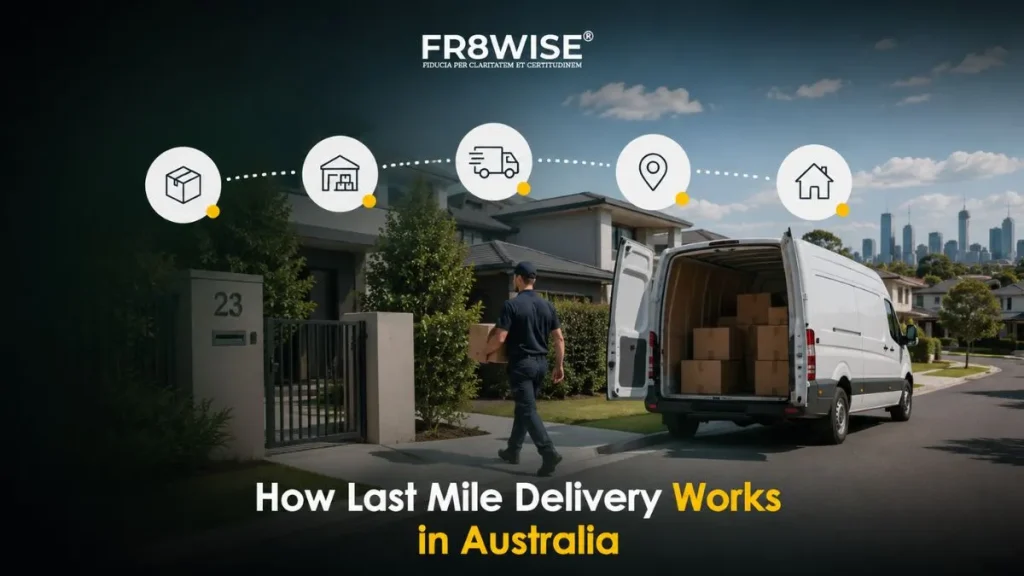
Last mile delivery in Australia typically involves a carrier picking up orders from a warehouse or fulfilment hub, sorting them at a depot, and delivering them on a route either to the customer’s door, a parcel locker, or a collection point.
Here’s what that process actually looks like step by step.
Order despatch from warehouse. The parcel gets picked, packed, labelled, and handed to a carrier. This might be Australia Post, a private courier, or a third-party logistics provider managing the despatch.
Carrier sortation. The parcel enters the carrier’s sortation network sorted by postcode and route, allocated to the right depot for final delivery.
Route allocation. A driver gets a route. That route might include 80 to 150 stops per shift, depending on density and parcel type.
Delivery attempt. The driver attempts delivery. If nobody is home, the parcel may be left in a safe place, taken to a parcel locker, returned to the depot for redelivery, or taken to a post office for collection.
Exception management. Failed deliveries, wrong addresses, damaged parcels, customer disputes these all require handling. This is where last mile costs blow out if processes aren’t tight.
Proof of delivery. The carrier records proof a signature, a photo, a GPS stamp and the customer gets a notification.
Courier Services Australia: Your Last Mile Delivery Options
When it comes to courier services in Australia, businesses typically choose between Australia Post, private couriers, same-day delivery services, parcel lockers, or a third-party logistics provider.
Australia Post
The most widely used option. Broad coverage including regional and remote Australia. Reliable for standard parcels, particularly under 5kg. Slower than private couriers for metro-to-metro delivery. The MyPost Business platform offers better rates and tracking for higher-volume senders.
Private Couriers
Sendle, Couriers Please, Aramex, TNT all competitive on metro speed and price at volume. Most plug straight into Shopify and WooCommerce. Labels and tracking get automated. Better for heavier parcels or faster metro delivery.
Same-Day Delivery Services
Available in major metro areas through services like Drive Yello, Sherpa, and some courier platforms. Higher cost per parcel, but increasingly expected by customers for certain product categories grocery, pharmacy, high-value items. Not viable for all businesses, but worth understanding for product categories where speed is a key purchase driver.
Parcel Lockers and Collection Points
Australia Post’s Parcel Lockers, 7-Eleven collection points, and similar services give customers a secure pickup option when they’re not home. Reduces failed delivery rates and redelivery costs. Uptake is growing, particularly in urban areas.
Third-Party Logistics (3PL)
A 3PL handles warehousing, picking, packing, and last mile despatch on your behalf. The right 3PL brings carrier relationships, technology integration, and operational expertise that most businesses can’t build cost-effectively on their own. For businesses scaling beyond the capacity of in-house fulfilment, a 3PL is often the most efficient last mile solution.
What’s Changing in Last Mile Delivery in Australia in 2026
Last mile delivery in Australia is going through significant change right now. These are the trends shaping it.
AI-Driven Route Optimisation
AI is now planning delivery routes in real time. It adjusts for traffic, weather, failed delivery attempts, and driver availability. Routes get updated on the fly to avoid congestion, port delays, or weather disruptions — keeping deliveries on schedule without manual intervention. For carriers, this cuts cost per stop and improves on-time rates. For businesses, it means fewer exceptions and more predictable windows.
Autonomous Delivery
Delivery robots and drones are being trialled in Australian cities. Still early. But the direction is clear. Labour shortages in the courier sector are pushing investment into automation. Warehouse robotics and autonomous mobile robots are already standard in many distribution centres. That same pressure is now moving into last mile delivery.
Mandatory Emissions Reporting
Mandatory carbon reporting is now reshaping supply chain decisions for Australian businesses. For last mile delivery, it’s starting to influence which couriers get chosen. Electric delivery vehicles are appearing on Australian streets. Some carriers offer verified carbon-neutral options. Businesses with sustainability targets are factoring this in.
Elastic Fulfilment
The concept of “elastic fulfilment” scaling delivery capacity up and down to match demand without fixed infrastructure is gaining ground in Australia. This includes on-demand courier platforms, crowd-sourced delivery networks, and flexible 3PL arrangements that can absorb volume spikes without the business needing to build that capacity itself.
Micro-Fulfilment Centres
Rather than fulfilling all orders from a single large warehouse, some businesses are establishing smaller fulfilment points closer to customer clusters. A micro-fulfilment centre in Melbourne’s western suburbs, for example, can deliver to much of metro Melbourne faster and cheaper than a warehouse in an industrial estate on the city’s outskirts. This model is growing, particularly for businesses where delivery speed is a direct competitive factor.

Common Last Mile Delivery Mistakes Australian Businesses Make
These problems come up repeatedly. Most of them are avoidable.
Relying on a single carrier. Every carrier has bad weeks. During peak season, congestion hits the whole network at once. A single-carrier strategy means every one of your customers absorbs those problems simultaneously. A multi-carrier approach gives you options.
Promising delivery times you can’t control. Customers want speed. But promising next-day when your warehouse or carrier can’t hit that window does more damage than being honest upfront.
Not tracking failed delivery rates. Most businesses know their overall delivery times. Fewer track failed first-attempt delivery rates by carrier and postcode. This data shows you exactly where your last mile operation is breaking down and where you’re losing money on redelivery attempts.
Ignoring the returns experience. A complicated return process is one of the fastest ways to lose a customer permanently. Easy returns prepaid label, simple process, fast refund build loyalty. Making returns difficult saves a small amount on logistics cost and loses significantly more in customer lifetime value.
Underinvesting in tracking and notifications. Customers want to know where their parcel is. Proactive notifications despatch, out for delivery, delivered reduce inbound customer service contacts dramatically. The cost of a good notification system is a fraction of the cost of handling “where is my order” queries manually.
Not planning for peak season. Last mile capacity doesn’t scale instantly. Carrier relationships, despatch volumes, and fulfilment processes all need to be planned ahead of peak periods not adjusted reactively when delivery promises start slipping.
How to Improve Last Mile Delivery Performance
Better last mile delivery comes from multi-carrier strategy, realistic delivery promises, strong tracking and notifications, optimised despatch processes, and proper peak season planning.
Use Multiple Carriers
Don’t put all your deliveries through one provider. Match carrier to order type. Australia Post for regional, private couriers for metro express, same-day services for time-critical orders. This gives you flexibility on cost and resilience when one carrier has issues.
Set Realistic Delivery Promises
Customers respond better to accurate promises than optimistic ones that fail. If your standard delivery is 3-5 business days, say so clearly. If you offer same-day delivery in select areas, be explicit about the coverage. Unmet expectations cause complaints. Met expectations build trust.
Optimise Your Despatch Process
If your warehouse despatches at 4pm, you’re missing same-day pickup windows for most carriers. Review your order cut-off times and despatch processes. Even moving cut-off by two hours can significantly improve the delivery speed your customers experience without changing your carrier.
Invest in Tracking and Customer Notifications
Real-time tracking and proactive notifications are baseline expectations now. Despatch, out for delivery, delivered customers want all three. If your setup doesn’t provide this, fix it. Fewer “where is my order” tickets alone usually covers the cost.
Measure Failed Delivery Rate
Track the percentage of first-attempt deliveries that fail, by carrier and postcode. This single metric tells you more about your last mile performance than almost anything else. High failure rates in specific areas or with specific carriers point to exactly where intervention is needed.
Work With a Logistics Partner
For businesses that have grown beyond the point where managing last mile delivery in-house is efficient, working with a logistics partner who has established carrier relationships, technology integration, and operational experience makes a measurable difference.
For businesses also looking to strengthen the broader supply chain behind their last mile operation including procurement strategy and international freight Think Global Logistics (TGL) offers specialist consulting across the full supply chain picture.
Frequently Asked Questions: Courier Services Australia
What is last mile delivery?
Last mile delivery is the final stage of shipping moving a product from a warehouse or depot to the customer’s address. It’s the most expensive and complex part of the delivery process, and the part that most directly affects the customer’s experience.
Why is last mile delivery so expensive in Australia?
Distance, low population density outside major cities, high labour costs, and rising customer expectations around speed and tracking all contribute to making last mile delivery in Australia more expensive than in comparable markets.
What is the best last mile delivery option for Australian e-commerce businesses?
It depends on your order volume, product type, and customer locations. Most growing businesses use a mix Australia Post for regional coverage, private couriers for metro speed, and same-day services for time-critical orders. A multi-carrier approach gives you better cost, speed, and resilience than relying on a single provider.
How do I reduce failed deliveries?
Accurate address capture at checkout, proactive delivery notifications so customers know when to expect their parcel, parcel locker options for customers who aren’t home, and tracking failed delivery rates by carrier and postcode to identify where intervention is needed.
What is same-day delivery and is it worth offering?
Same-day delivery means the order is dispatched and delivered within the same day, usually only available in metro areas. It’s a premium option that works best for higher-margin products or businesses where speed is a key competitive factor. Not worth offering if the economics don’t support it at your current margins.
How does last mile delivery connect to the rest of the supply chain?
Last mile performance depends heavily on what happens before it, how fast the warehouse despatches, whether inventory is accurate, or how reliable the upstream freight operation is. A business with last mile delivery problems often has upstream supply chain issues that are the real root cause.
What’s changing in last mile delivery in Australia in 2026?
AI-driven route optimisation, autonomous delivery trials, mandatory emissions reporting affecting carrier selection, micro-fulfilment centres closer to customer clusters, and elastic fulfilment models that scale delivery capacity with demand rather than requiring fixed infrastructure.
How FR8WISE Supports Last Mile Delivery in Australia
The FR8WISE supply chain team works with Australian businesses to build delivery operations that are reliable, cost-effective, and built to handle growth.
Last mile delivery doesn’t exist in isolation. It sits at the end of a supply chain that starts with procurement, runs through freight forwarding and customs, and passes through warehousing before a parcel ever reaches a carrier. Problems at the last mile often have upstream causes. A warehouse that despatches late. A freight operation that can’t replenish stock fast enough during peak season. An inventory system that oversells and creates fulfilment failures.
FR8WISE looks at the whole chain. That means the recommendations we make actually fix the problem rather than treating the symptom.
Whether you’re struggling with delivery costs, carrier performance, failed deliveries, returns, or trying to build a last mile strategy that can scale FR8WISE can help.