


Written by the FR8WISE Supply Chain Team | FR8WISE is a Sydney-based logistics and supply chain consultancy working with Australian businesses across 14 industries to improve freight forwarding, customs compliance, and end-to-end supply chain performance.
For most this is one of those aspects of the supply chain not considered until it causes a problem; customs clearance.
A shipment is waiting at the port for two weeks. Unexpected charges for duty. Goods are retained for examination and fall behind schedule. In some cases, the cargo is completely impounded or returned.
The damage is done financially, operationally and sometimes in the customer relations area , at that time.
This guide is designed to take you through customs clearance Australia step-by-step. What it means, how it operates, the costs, and common mistakes and how businesses can avoid them.
What Is Customs Clearance?
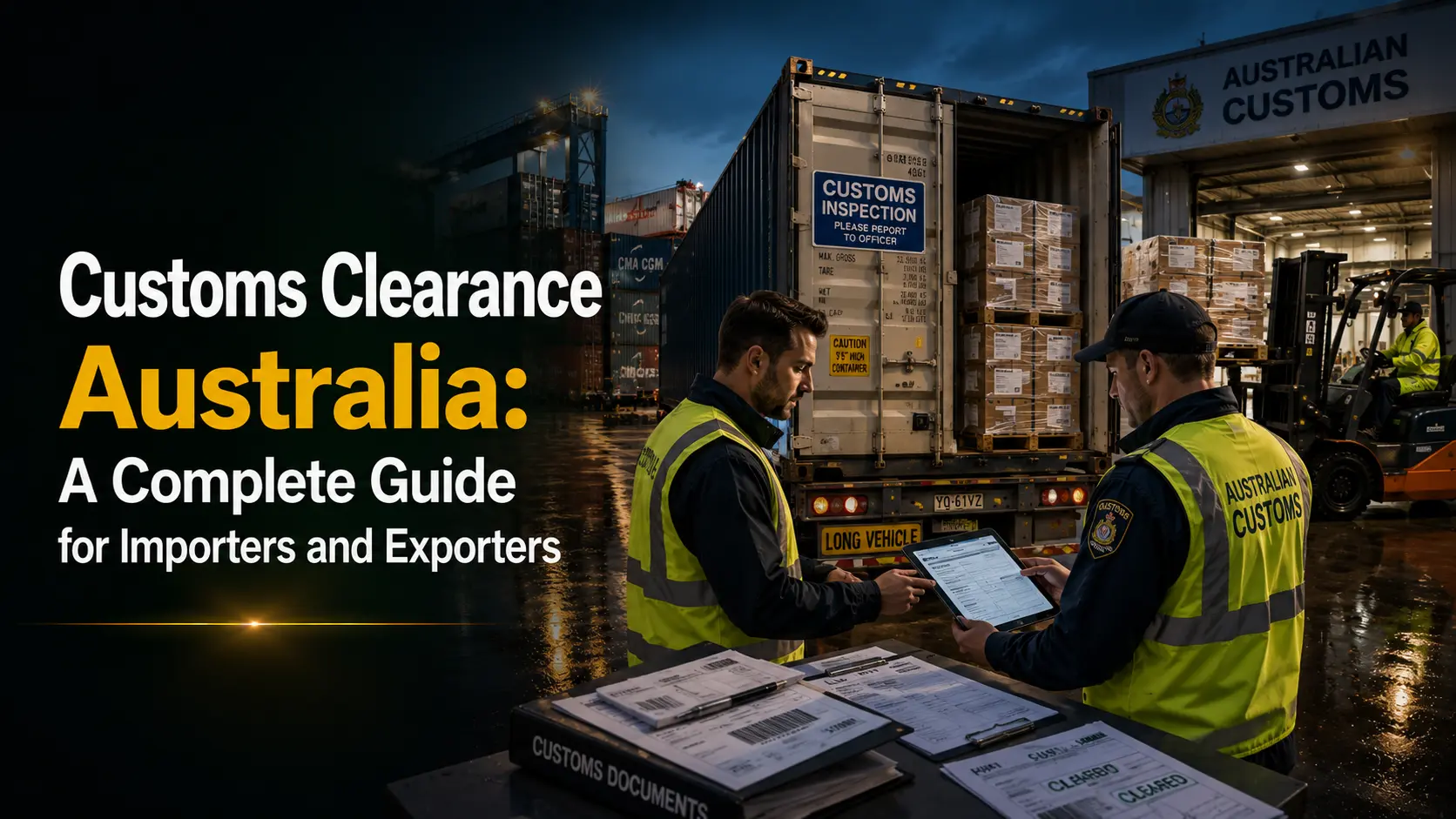
Clearing Goods from Customs Australia involves submitting the necessary documents to Australian Border Force (ABF) and getting official clearance to import or export goods legally.
This is the process that is required for every commercial shipment that enters or leaves Australia. It is applicable to imports by sea, air and road. It is applicable to goods exported to overseas destinations. It also works for any business size and any type of product value, although the essentials differ immensely for different products shipped and received from different sources.
The process of customs clearance is not a routine matter. Compliance is a real function – with real consequences for regulation. Errors in the declarations, lack of permits or misclassification of goods may lead to delays, fines, seizure of goods and even legal action in extreme instances. Thus, knowledge of its operation is vital to any business engaged in international trade.
How Customs Clearance Works in Australia
The customs clearance process in Australia includes submitting the import or export declaration to the Australian Border Force, paying any duties and taxes, and receiving clearance for the goods to be released.
But, the process is more complex than this summary implies. This is how it really operates in practice.
Preparation of Documentation
Before a shipment can be cleared, the right documents must be in place. For imports, these typically include:
- Commercial invoice , showing the supplier, buyer, description of goods, quantity, and declared value
- Packing list , detailed breakdown of what’s in each carton or pallet
- Bill of lading or airway bill , the transport document issued by the carrier
- Certificate of origin , confirming where the goods were manufactured
- Import permits or licences , required for certain controlled or restricted goods
- Phytosanitary or health certificates , required for food, agricultural products, and organic materials
The most common reason for customs delays is that they are missing or incorrect. This means that it will be much more efficient to get documentation correct just before the shipment leaves the origin country, than it will be to solve problems once the shipment has arrived at the destination country.
Lodgement of the Import Declaration
Import declarations are made in Australia electronically using the ABF’s Integrated Cargo System (ICS). This is done by most businesses by means of a licensed customs broker, as the classification and valuation rules are complicated, and errors are expensive.
The declaration contains the tariff classification (Harmonised System code), customs value, country of origin and importer of record information.
Assessment of Duties and Taxes
The ABF uses the declaration to work out the customs duty to be paid for the goods. Apart from the duty, most of the imported items are also liable to Goods and Services Tax (GST) at a rate of 10% on the customs value + duty + freight and insurance.
The rate of duty will vary depending on the tariff classification of the goods and its country of origin. A free trade agreement with a number of countries, such as the United States, Japan, South Korea and the ASEAN agreement, can remove or lower duty on eligible products. However, the FTA concession must be claimed appropriately with supporting evidence of origin in the declaration.
Risk Assessment and Examination
An automated risk assessment system is used by the ABF to identify shipments for examination. The vast majority of shipments are not inspected in person. But some are chosen to be examined – either because the goods are deemed to be in a high-risk category, because the importer has been flagged up for compliance concerns or just as a result of regular random selection.
The examinations can vary from document review to complete physical checking of the cargo. These increase the time and expense of the clearance process. In addition, if biosecurity issues are suspected during inspection, goods may be asked to be treated (fumigated, irradiated or other approved treatments) before they can be released.
Payment and Release
After the duties and taxes have been assessed and paid and any examination requirements fulfilled, the ABF will issue clearance. The goods are then allowed to be released from the port or airport and the final destination is reached.
In the case of sea freight, clearance is usually sought prior to the arrival of the vessel in Australia, allowing the goods to be released on arrival. With air freight, the quicker the delivery time, the shorter the time window.
What Is a Customs Broker?
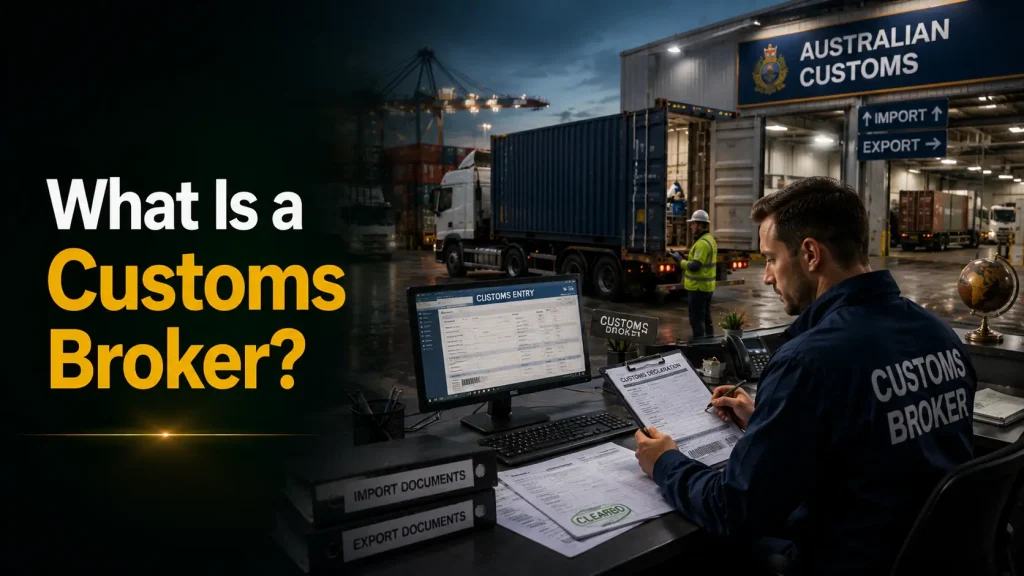
A customs broker prepares and submits customs applications in the name of importers and exporters to ensure goods are classified, valued and documented properly to comply with Australian Border Force requirements.
Customs brokers in Australia are required to register with the ABF for a licence. Passing a formal examination on customs law, tariff classification, valuation and trade compliance is required for licensing. A licensed customs broker will then have the expertise that businesses may not have.
Businesses do not have to work with a customs broker, they can file their own declarations. But in the intricacies of classification, the possibilities of mistakes and the time required to oversee the process make most importers and exporters choose to hire a customs broker rather than handling the matter on their own.
A successful customs broker isn’t just a paper pusher. They provide guidance on tariff classification, anticipate FTA concession opportunities, preemptively address biosecurity issues, coordinate with the ABF, and address any queries or examinations that may occur. To sum up, they mitigate compliance risk and eliminate internal resources.
Tariff Classification: Why It Matters
Tariff classification involves assigning an internationally standardised Harmonised System (HS) code to imported or exported goods, thereby identifying the applicable rate(s) of duty and if applicable, permits or restrictions will apply.
One of the most technically challenging areas of customs clearance in Australia – and one of the most error-prone!
Each product comes with its own HS code. An eight or ten digit number used to organize products by product description, material, and function. The duty rate is dependent on the classification. It also helps to decide if any import permits are needed, whether biosecurity measures are required and whether any ‘trade remedies’ (anti-dumping duties) are in effect.
A misclassification in either direction causes difficulties. Underclassing goods is a failure to pay compliance duty , namely the duty payable based on the lowest duty code applicable to the goods. Overclassing – assigning a higher duty code – is a waste of duty.
In addition, for the same product the same grade may be valid and suitable for a different purpose, have a different composition, or be presented in a different manner for import. That’s why tariff classification is a specialty and if you rely on the HS code a supplier suggests without checking, you are risking it.
Customs Valuation: How Duty Is Calculated
Customs valuation is the procedure used to determine the value of import goods for the purpose of calculating customs duty and GST – usually in line with the transaction value, which is defined as the price actually paid or payable for the goods.
Australia is a signatory to the World Trade Organisation’s Customs Valuation Agreement which offers a hierarchy of valuation methods. Typically the customs value is the transaction value (invoice price) with some extras in the customs value, including freight to the port of the export and insurance.
But the customs value is not strictly speaking the invoice price. There are a few changes that might be needed:
- Additions: Commissions, royalties, assists (materials or tooling provided to the supplier free of charge), and certain transport costs may need to be added to the invoice price.
- Deductions: Certain costs incurred after the goods arrive in Australia , such as installation, training, or post-importation warranty , may be deducted.
Furthermore, the ABF may ask for an explanation of the customs value if it seems to be inconsistent with the market price of similar goods. There is a special focus on transfer pricing between related companies.
Correct customs value is important because it will have a direct impact on the duty and GST payable. A compliance failure (deliberate or otherwise) to undervalue goods can have serious consequences.
Free Trade Agreements and Duty Concessions
Australia has over a dozen countries with free trade agreements that can give access to goods imported into Australia without customs duty, if the conditions of entry are right , but the benefits have to be claimed correctly to be available.
One of the most beneficial aspects of customs arrangement for importers from Australia is this. There can be substantial savings. For instance, the majority of Chinese imports into Australia are now duty free under ChAFTA (the China-Australia Free Trade Agreement), whereas the general rate of duty was up to 5% or above before the agreement. Concessions are similar under FTA with the US, Japan, South Korea, ASEAN countries, UK, India and others.
To claim an FTA concession, importers must:
- Confirm that the goods meet the rules of origin requirements for the relevant FTA
- Obtain the required origin documentation , typically a Certificate of Origin or a supplier’s declaration
- Correctly claim the concession in the import declaration
The potential saving is lost if the concession is not claimed , or claimed incorrectly , then the standard duty rate applies. Furthermore, if the concession is awarded incorrectly (for example, for goods that do not comply with the rules of origin), the importer may be required to pay the duty that he/she underpaid and the penalties.
A customs broker who is knowledgeable about FTA can determine what concessions, if any, are available on their products and trade lanes and make sure that the claims are being made properly and the proper documentation is in place.
Biosecurity and Quarantine Requirements
Australia’s biosecurity requirements are among the most stringent in the world and goods may be treated, detained, re-exported or destroyed at the importer’s expense if the biosecurity requirements are not met.
Australia’s geographical isolation has maintained a generally disease-free agricultural environment which is highly valuable for the economy. Biosecurity is applied at the border by the Department of Agriculture, Fisheries and Forestry (DAFF) to ensure that that environment is kept free from pests, diseases and contaminants that could cause catastrophic damage if they were introduced.
For importers, biosecurity requirements mean:
Pre-arrival documentation. There are many products that need permits or advance documentation by DAFF before entering Australia. Products of agriculture, wood and wood packaging, some food products, and organic products are all under the microscope.
Inspection. Goods can be chosen to be inspected for biosecurity at the border. Inspectors inspect for live insects, soil, plant material and other biosecurity problems. The presence of any of these may be grounds for treatment or refusal of admission.
Treatment. Goods may require fumigation, heat treatment or other approved treatment to be released if there is a biosecurity risk. The importer is responsible for the treatment costs. Additionally, treatment contributes days to clearance time.
Packaging requirements. All wood packaging material (pallets, crates and dunnage) should be subject to ISPM 15 (International Standards for Phytosanitary Measures) treatment, either by heat or fumigation with methyl bromide. If not properly packaged, the entire shipment may be detained.
The best approach to biosecurity risk is to know what it is before packing and sending the shipment. A customs broker/freight forwarder with a solid understanding of biosecurity can pre-plan your product and packaging needs before your shipment departs the supplier.
Import Permits and Restricted Goods
Furthermore, certain products are eligible for trade remedies (anti-dumping or countervailing) in addition to regular duty rates. These are constantly changing and should be verified on importation.
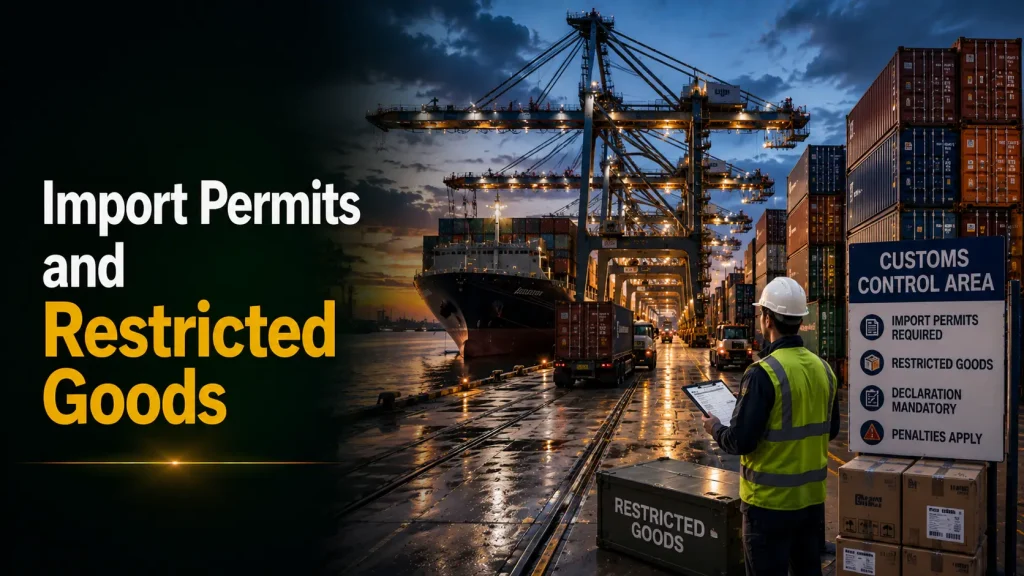
The range of goods subject to import controls in Australia is broad. It includes:
- Food and agricultural products , subject to biosecurity requirements and, in some cases, specific import conditions
- Medicines and therapeutic goods , regulated by the Therapeutic Goods Administration (TGA)
- Chemicals , certain industrial and agricultural chemicals require permits under the Industrial Chemicals Act
- Weapons and firearms , strictly controlled and require specific permits
- Wildlife and wildlife products , regulated under CITES (Convention on International Trade in Endangered Species)
- Second-hand machinery and vehicles , may require inspection and compliance certification
- Asbestos-containing materials , prohibited from import
The challenge for importers is to be aware of any permits/ restrictions that may be required for their particular merchandise prior to the shipment leaving. Finding a permit need after cargo has arrived at port is a big problem because of the added costs.
Goods are also subject to customs clearance when exported from Australia – that is, an export declaration is lodged with Australian Border Force prior to the goods departing Australia.
Export Customs Clearance in Australia
Exporting goods from Australia also requires customs clearance , specifically, the lodgement of an export declaration with Australian Border Force before the goods leave the country.
The clearance process for export is normally simpler than import clearance for most commodities. There are however some important requirements to be aware of for exporters.
Export declarations For commercial shipments, above certain thresholds, must be lodged. The declaration contains information about the goods, the value of the goods, the place of delivery and the exporter of record.
Prohibited and restricted exports In some cases exist for goods , in particular for goods with potential defence or dual-use applications, wildlife and heritage goods and some agricultural goods. Violation of the conditions of export is a grave offence.
Export documentation for overseas customs. In addition to complying with the requirements of the ABF, exporters must have documentation that complies with the requirements of the country to which they are exporting. Many destination documents are requested such as certificates of origin, phytosanitary certificates, health certificates and more. Without adequate documentation on arrival delays or refusal of entry will occur at the other end.
FTA origin documentation. An FTA concession on the imported goods will generally be required by the buyer of the goods in the destination country which will be issued by the Australian exporter as a Certificate of Origin. The exporter’s responsibility is to prepare this correctly and make sure that the products really comply with the rules of origin.
Common Customs Clearance Mistakes in Australia
These problems come up repeatedly with Australian importers and exporters. Most of them are avoidable.
Incorrect HS code. One of the most common mistakes made in customs declaration is the use of the wrong tariff classification code. This may lead to under payment of duty (compliance issue), overpayment of duty (unnecessary cost) or wrong application of biosecurity or permit requirements. Therefore, it’s highly recommended to verify the HS codes independently, as the supplier may offer an incorrect code.
Undervaluing goods. Declarating a customs value that is lower than the actual transaction value (whether it was intentional or not, because of a lack of understanding of what should be included) is a compliance issue. The ABF has an advanced system in place to detect undervaluation and the consequences are severe.
Missing FTA concession claims. Many importers pay the standard duty rate on goods that are entitled to FTA concessions, simply because they don’t know about the concession, or lack the necessary documentation of origin. This is a direct and preventable expense.
Non-compliant wood packaging. A common occurrence of holds is pallets and crates not complying with ISPM 15. The answer is that as long as your supplier provides compliant packaging, the issue can be avoided, but the question is, how can you realize the issue before the shipment leaves the dock?
Late lodgement of declarations. Ideally, import declarations should be made before the arrival of the vessel or aircraft. Late lodging can cause delays to the port/airport process, storage and demurrage charges can mount up.
Inadequate record-keeping. Under Australian customs laws, importers/exporters are required to keep records of their imports/exports for 5 years. In addition, those records should be adequate to substantiate the accuracy of customs declarations. Not having adequate records is a compliance risk, especially if an ABF audit is performed.
Not checking for anti-dumping duties. There may be additional duties, over and above normal duty rates, imposed on certain goods from certain countries due to anti-dumping and countervailing duties. Not all of these are well advertised and the importer may receive a surprise bill.
Customs Audits and Compliance Reviews
Australian Border Force (ABF) carries out post clearance audits of importers to confirm that goods have been classified, valued and declared correctly and all duties and taxes have been paid.
An audit by an ABF does not always indicate a problem. Random audits and targeted audits based on risk profiling are carried out by the ABF. But when an audit reveals mistakes, it can result in substantial liabilities for businesses that have accrued an incorrect importation, including unintentional importations.
Typical audit issues are misclassification of the tariff item, undervaluation, false declaration of country of origin, failure to claim or improperly claim FTA, etc. In addition, not keeping good records is more difficult to prove when an audit occurs.
Preparation for a customs audit is the systematic compliance from the beginning. It involves the correct use of HS codes, full documentation of all shipments, the appropriate use of FTA concessions and documentation to support it, and the retention of records for the required five-year period.
Voluntary disclosure of errors, prior to the announcement of an audit, results in much lower penalties than errors discovered through an audit. If necessary, a customs broker or trade compliance adviser can assist in the voluntary disclosure procedures.
 Customs Clearance Costs in Australia
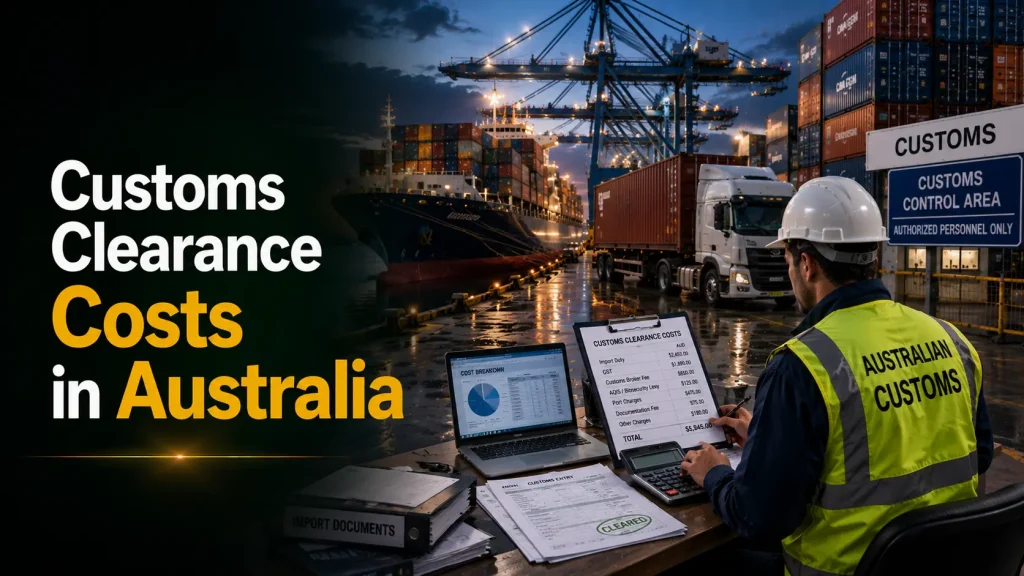
Customs clearance fees in Australia are customs duty, customs broker fees, port charge, examination fee and , if applicable , biosecurity treatment fees.
Here’s a breakdown of what to expect:
Customs duty. Calculated as a percentage of the customs value. These rates differ depending on the product, many goods are subject to 0% duty other products are subject to 5% or more. FTA concessions may waive or abate duties on eligible items.
There is a 10% tax on the customs value, duty and international freight and insurance. Uses for the majority of imported products. For eligible businesses, the net cost is zero as they can claim this as input tax credit.
Customs broker fees. Varying among brokers and depending on the complexity of the shipment. The cost of entry preparation for a basic import can be anywhere from approximately $150 to $400 or higher. This is the cost of adding to the complexity of the shipment, more lines or more services.
Port and terminal charges. These are levied by the port or terminal operator and comprise fees charged for examining containers when they are chosen for inspection.
Examination fees. The cost of the importer’s goods being examined in ABF is the importer’s responsibility. This means charges for transporting the goods to an examination area, unpacking and repacking of goods where necessary.
Biosecurity treatment costs. The importer incurs fumigation or other biosecurity treatment costs if the goods need to be treated. The cost of treatment depends on the amount of material and the type of treatment used and can be high for large quantities of material.
Demurrage and storage. When clearance is delayed, for any reason (documentation, examination or treatment), storage charges are applied at the port or terminal. These can be significant in the case of containers used for sea freight, especially in busy ports such as Port Botany and Port of Melbourne.
How to Improve Your Customs Clearance Process
Better customs clearance performance is all about preparation, choice of broker, documentation, proactive compliance and the mindset of considering customs as a value added function as opposed to a reactive one.
Work With an Experienced Customs Broker
This is the one best step that most businesses can take. A reliable customs broker minimises compliance risk, identifies concession opportunities through the FTA, takes proactive steps to address biosecurity requirements and efficiently communicates with the ABF. Delays, duties and penalties will almost always cost more than the cost of a customs broker.
Invest in Documentation Quality
Most customs delays are caused by documentation errors or omissions. This means it can be beneficial to create a checklist of documentation requirements for each product and trade lane, and to ask suppliers to adhere to this. Before the goods start to come in, consult the suppliers’ documentation.
Conduct Regular Tariff Classification Reviews
HS codes change. Products change. Trade pacts result in additional concessions. The classification of a tariff which was right two years ago may not be as favorable as it is now. So making sure that you do conduct a periodic review of your HS codes, especially those for your highest volume and highest-dollar goods, can help you discover potential compliance problems and duty savings.
Build Compliance Into Procurement
The journey toward customs compliance begins before ordering the goods. Customs implications include sourcing decisions and supplier location, product specifications and packaging requirements. Therefore, using customs expertise as part of the procurement process (rather than as post to arrival process) helps minimize risk of issues arising after goods have been shipped and in transit.
Maintain Proper Records
The data from the five years of transactions is enough to prove customs declarations. This is NOT a choice, it is a legal requirement. Also, well-kept records speed up the audit and they cause less disruption when you have to go through an audit , and they lessen the liability if you find that you’ve made a mistake.
Frequently Asked Questions:
What is customs clearance in Australia?
Customs clearance refers to the process of submitting paperwork to Australian Border Force and getting clearance for goods to legally cross the country’s borders. It requires lodging a declaration, payment of duties and taxes and compliance with any biosecurity and permit requirements.
How long does customs clearance take in Australia?
The clearance of most sea freight shipments can be expedited within 1 to 2 days if the documentation is complete and if the goods are not chosen for examination. If products are retained for inspection or biosecurity treatment, however, it can take several days to a week or more for clearance. Clearance via air is normally quick, such as arrival on the same day.
Do I need a customs broker in Australia?
Using a customs broker is not compulsory. But with the complexity of tariff classification, valuation rules, FTA concessions and biosecurity requirements, most businesses determine that they are better served by using a licensed customs broker than by handling customs on their own, which would incur a higher compliance risk and cost.
What is an HS code?
An HS code or Harmonised System code is a standardised number used to classify goods for customs purposes that is used worldwide. It specifies the duty rates for the goods, and any permits, restrictions or biosecurity requirements that apply.
How is customs duty calculated in Australia?
Customs duty is imposed on the basis of percentage of the customs value of goods. The rate is based on the HS code and country of origin. Qualifying goods may be imported duty free under FTA concessions. GST 10% is also applicable on the customs value + duty + international freight + insurance.
How FR8WISE Supports Customs Clearance in Australia
The supply chain team at FR8WISE assists Australian importers and exporters in customs clearance, as part of an overall integrated supply chain strategy.
Customs clearance is not as effective when done individually. It’s linked to freight forwarding, warehousing, inventory management and procurement. For instance, if a sourcing decision shifts the production from a non-FTA country to a country with preferential duty rates, then the duty cost can be considerably lowered. Likewise, the removal of a biosecurity hold due to a change in packaging specification could make a positive impact on time and money on each shipment.
FR8WISE explores these relationships. We proactively identify risk to customs compliance before it becomes an issue. We identify duty savings which businesses were not aware of. We are building custom processes that are efficient to scale – not just for volume but for where the business is going.
Think Global Logistics (TGL) provides businesses with specialist advice throughout the international trade and logistics spectrum, if they wish to receive strategic support with their international trade planning and global supply chain strategy.
From implementing customs processes for the first time through to compliance problems and reducing duty costs for an expanding import programme, FR8WISE can help you.